🧭 Summary
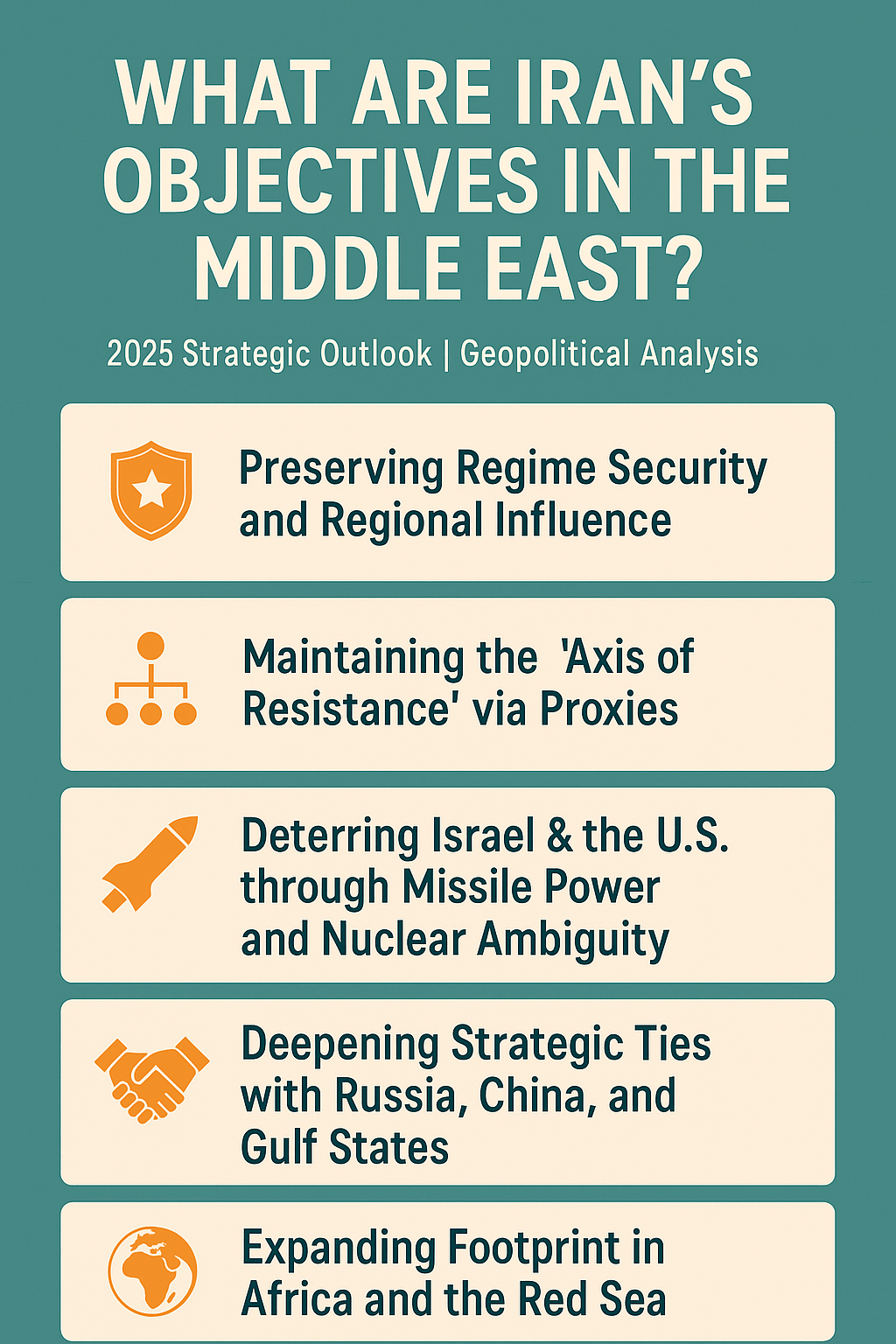
Iran’s strategic goals in the Middle East revolve around five pillars:
- Regime preservation and deterrence
- Expanding and sustaining its proxy network
- Building nuclear and missile capabilities
- Strengthening alliances with Russia, China, and Gulf States
- Extending its influence into Africa and the Red Sea
As regional tensions peak in 2025, Iran’s role is more pivotal—and controversial—than ever.
1. Regime Survival & Strategic Deterrence
In June 2025, following Israel’s “Operation Rising Lion”, Iran’s military and nuclear infrastructure sustained major strikes. Despite this, Iran’s regime has stayed intact, backed by a loyal base and lack of viable opposition.
Key Focus:
- Deterrence through advanced missile systems
- Institutional support via the IRGC (Islamic Revolutionary Guard Corps)
- Cyber and asymmetric warfare to offset conventional inferiority
Iran’s strategy hinges on survival through strength, especially when facing growing threats from Israel, the U.S., and Gulf Arab states.
2. The Axis of Resistance: Expanding Proxy Power
Iran’s core objective in the region is to project power without direct engagement. Its support for proxy groups helps counterbalance U.S.- and Israeli-backed coalitions.
Key Proxies Supported by Iran:
- Hezbollah in Lebanon
- Hamas in Gaza
- Houthis in Yemen
- Shiite militias in Iraq and Syria
This “Axis of Resistance” allows Iran to maintain military reach across multiple borders, draining resources and attention from its rivals.
3. Nuclear Strategy and Missile Capabilities
In 2025, Iran has moved toward greater nuclear ambiguity, threatening to exit the Non-Proliferation Treaty (NPT).
Missile Program Highlights:
- A vast arsenal of ballistic missiles capable of reaching Tel Aviv, Riyadh, and U.S. bases
- Increased frequency of test launches amid regional tensions
- Strengthened air-defense systems post-Israeli strikes
This creates strategic uncertainty, allowing Iran to negotiate from a position of strength—even without confirmed nuclear weapons.
4. Shifting Alliances: Russia, China & the Gulf
As Western sanctions tighten, Iran has pivoted East:
- Russia: Signed a 20-year Comprehensive Strategic Partnership in Jan 2025. Includes arms deals, cybersecurity, and sanctions cooperation.
- China: Continued execution of a 25-year pact involving oil-for-infrastructure agreements and strategic investments.
Gulf Diplomacy Efforts:
- Reviving indirect talks with the U.S. via Oman and Qatar
- Engaging in quiet diplomacy with Saudi Arabia despite Yemen tensions
These relationships allow Iran to sidestep Western isolation while cementing alternative economic and military pathways.
5. Expanding Influence in Africa and the Red Sea
Iran is establishing a strategic presence in Africa, particularly in Sudan:
- Deploying military advisors and drones to the Sudanese Armed Forces
- Eyeing strategic ports like Port Sudan for access to the Red Sea
- Countering UAE and Saudi influence in East Africa
This gives Tehran a broader operational theater and access to maritime chokepoints vital to global trade.
6. Balancing War and Diplomacy
Iran’s playbook in 2025 is a mix of escalation and outreach:
- While launching retaliatory missile strikes, it has signaled interest in negotiations—particularly if Israel pauses its offensive.
- Tehran has used international forums to portray itself as the victim of aggression, appealing to neutral countries and the Global South.
This dual strategy keeps adversaries uncertain and provides room for diplomatic maneuvering when pressure becomes too high.
📊 Strategic Implications
- Prolonged Confrontation: With Israel-Iran tensions at historic highs, the Middle East faces a period of extended instability.
- Proxy Escalation: Increased funding and military supplies to non-state actors may trigger spillover into neighboring states.
- Global Realignment: Iran’s growing ties with Moscow and Beijing are redefining power dynamics far beyond the Middle East.
Iran’s 2025 regional objectives reflect a high-stakes balancing act: wielding power through indirect conflict while remaining open to tactical diplomacy. From Hezbollah to the Red Sea, and from nuclear deterrence to Eurasian partnerships, Iran is rewriting its regional playbook under immense pressure.
 WEBRONAQ.COM