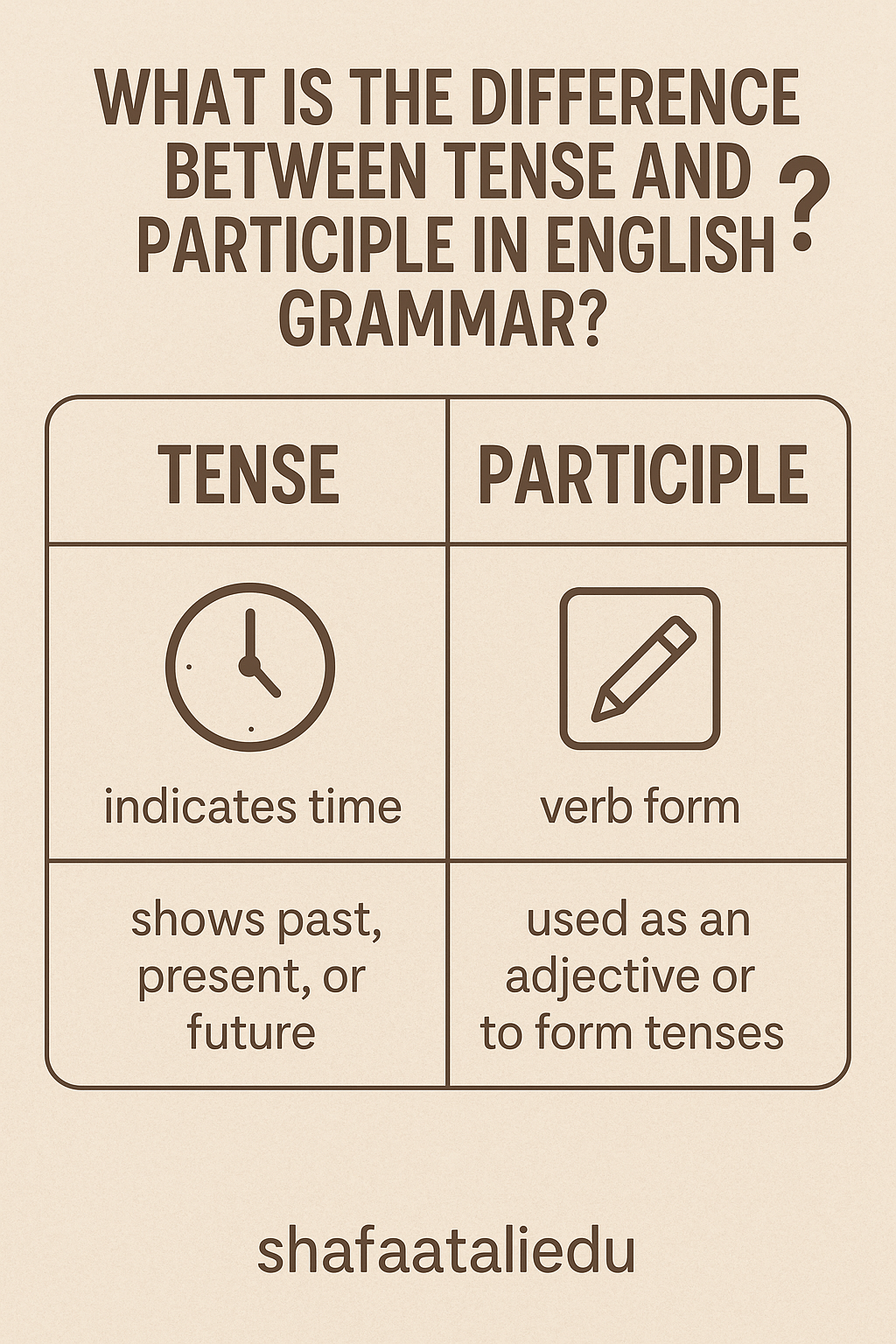
Tense and participle may sound similar, but they serve very different roles in English grammar. Let’s break them down simply.
Tense tells you when an action happens—past, present, or future. It’s all about time. For example:
- I walk to school. (Present tense)
- I walked to school. (Past tense)
- I will walk to school. (Future tense)
Tenses change the entire verb form depending on the time of action.
On the other hand, a participle is a verb form used to create other structures, like verb tenses or adjectives. There are two main types: present participles (ending in -ing) and past participles (usually ending in -ed or irregular forms like eaten, gone, written).
Here’s a quick look:
- Present participle: eating, running, smiling
- Past participle: eaten, played, driven
Participles do not show time on their own. Instead, they work with helping verbs to form tenses:
- She is running. (Present participle + is = present continuous tense)
- He has eaten. (Past participle + has = present perfect tense)
Also, participles can act like adjectives:
- The broken window (Here, broken describes the window)
So, in short:
- Tense = when something happens
- Participle = helps form tenses or describe things
Think of tense as the clock and participles as tools that help build meaningful sentences based on time.
Understanding both gives you the power to speak and write with clarity!
 WEBRONAQ.COM