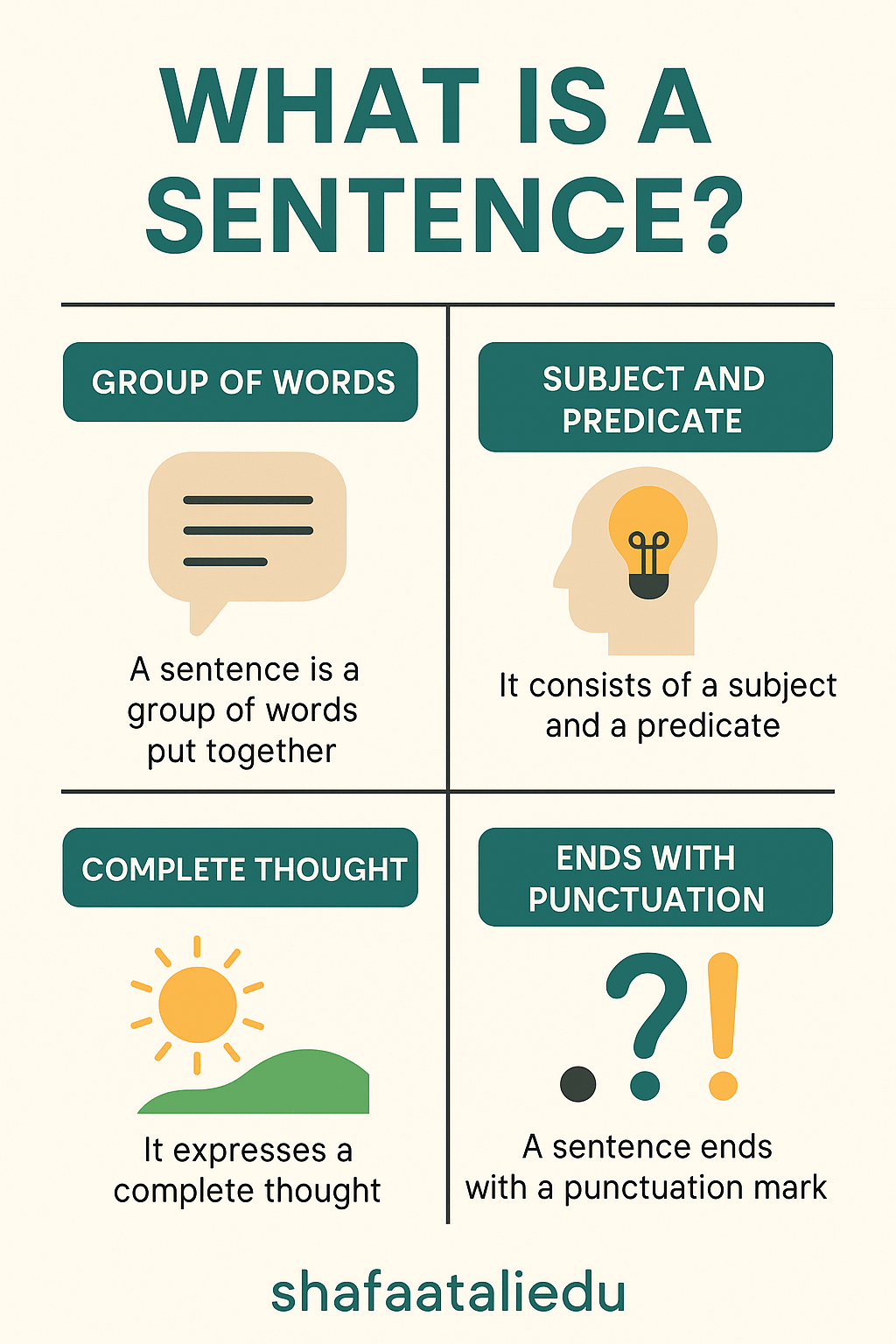
A sentence is a group of words that expresses a complete thought. It always starts with a capital letter and ends with a punctuation mark—usually a period (.), question mark (?), or exclamation point (!). Think of a sentence like a full package: it includes a subject (who or what the sentence is about) and a verb (what the subject is doing).
Here’s a simple example:
“The dog barked.”
- The dog is the subject.
- Barked is the verb.
Together, they form a complete idea.
Now, imagine you only said “the dog.” That feels incomplete, right? It leaves you wondering what happened with the dog. That’s not a sentence—it’s just a sentence fragment.
Sentences can be short or long, but the key is that they must make sense on their own. For example:
- Short: “She runs.”
- Long: “After finishing her homework, she ran quickly to the park to meet her friends.”
Both are valid sentences because they give you a full idea.
There are four main types of sentences:
- Declarative – gives information. “I like pizza.”
- Interrogative – asks a question. “Do you like pizza?”
- Imperative – gives a command. “Eat your pizza.”
- Exclamatory – shows emotion. “I love pizza!”
Understanding sentences is the first step to writing clearly and effectively. Whether you’re texting a friend or writing an essay, sentences are your basic building blocks.
As you continue learning, try spotting the subject and verb in everyday sentences—it’s a great way to boost your grammar skills!
 WEBRONAQ.COM