Imagine trying to talk to someone who only understands two words: yes and no. At first, it seems limiting, but with enough combinations, you could actually communicate anything! That’s exactly how computers work, and their special “yes/no” language is called binary code.
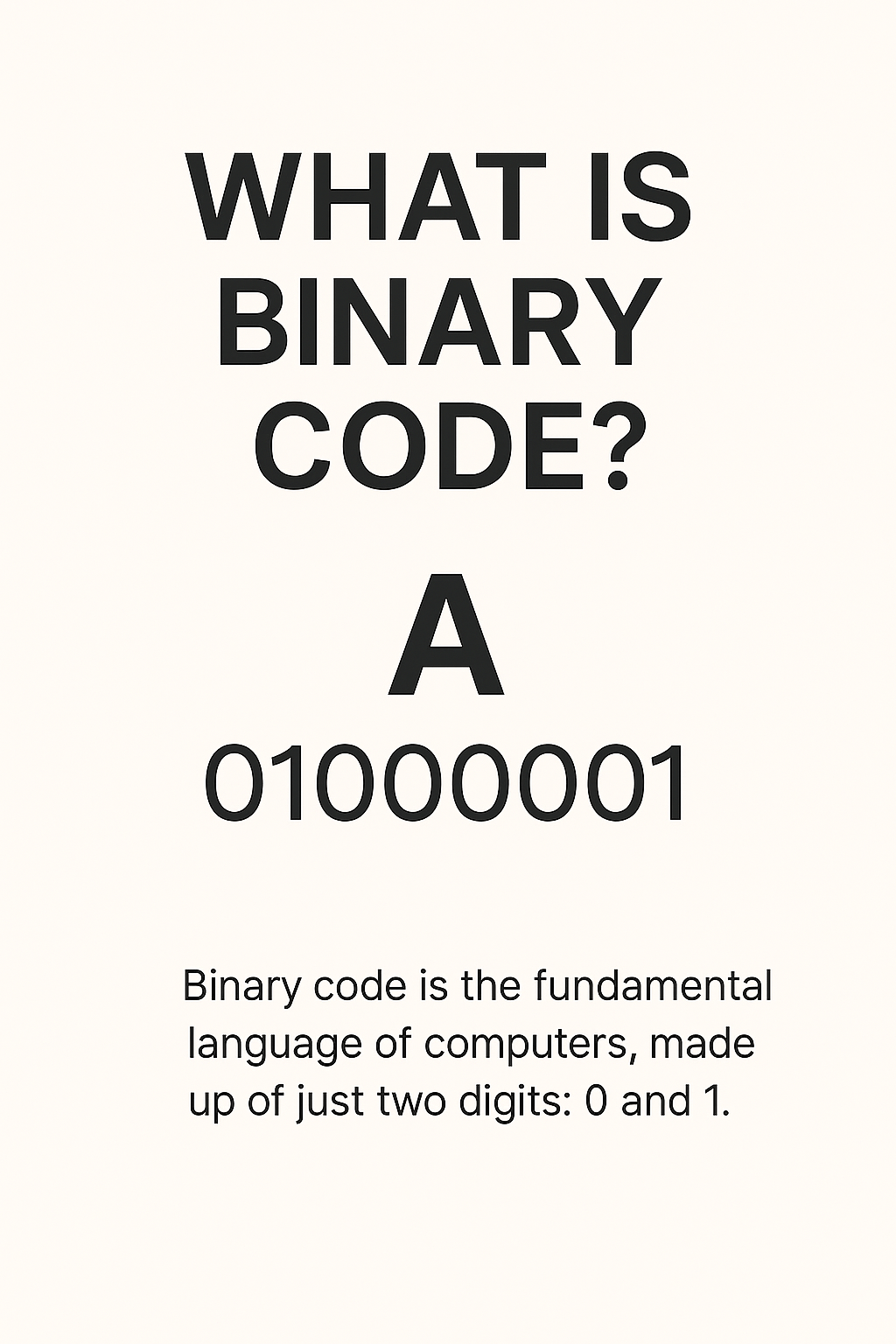
Binary code is the fundamental language of computers, made up of just two digits: 0 and 1. Instead of words or numbers we use every day, computers rely on these tiny switches, known as bits. Think of a light switch: it’s either off (0) or on (1). By stringing lots of these switches together, computers can represent letters, numbers, pictures, sounds, and even videos.
For example, the letter A in binary is written as 01000001. At first glance, that looks confusing, but behind the scenes, the computer instantly translates it into something meaningful. Just like Morse code uses dots and dashes, binary uses zeros and ones.
Here’s a simple way to picture it: imagine writing notes with only two colors, black and white. By arranging them in different patterns, you could create an image. Binary works the same way—zeros and ones are combined in patterns to represent information.
Why is binary so important? Because computers are built on electronic circuits, which naturally have two states: on and off. This makes binary the most reliable, efficient way for machines to process and store information.
In today’s world, every text you send, every photo you upload, and every video you watch is powered by billions of tiny binary instructions working silently in the background.
So, while it may look like a jumble of 0s and 1s, binary code is actually the heartbeat of modern technology. And who knows? In the future, we might see new codes beyond binary, unlocking even faster ways for machines to “think.”
 WEBRONAQ.COM