Photolithography is a key manufacturing process used to create extremely small patterns on materials, especially in the electronics industry. It plays a major role in making microchips, computer processors, and many modern electronic devices we use every day.
In simple terms, photolithography uses light to transfer a pattern onto a surface. This process allows manufacturers to build tiny circuits that are far smaller than what the human eye can see.
Let’s break it down step by step and understand why photolithography is so important.
What Is Photolithography?
Photolithography is a technique used to print circuit patterns onto a surface, usually a silicon wafer. These patterns later become the electrical paths inside microchips.
The word “photolithography” comes from:
- Photo – light
- Lithography – printing or patterning
So, photolithography literally means patterning using light.
How Does Photolithography Work?
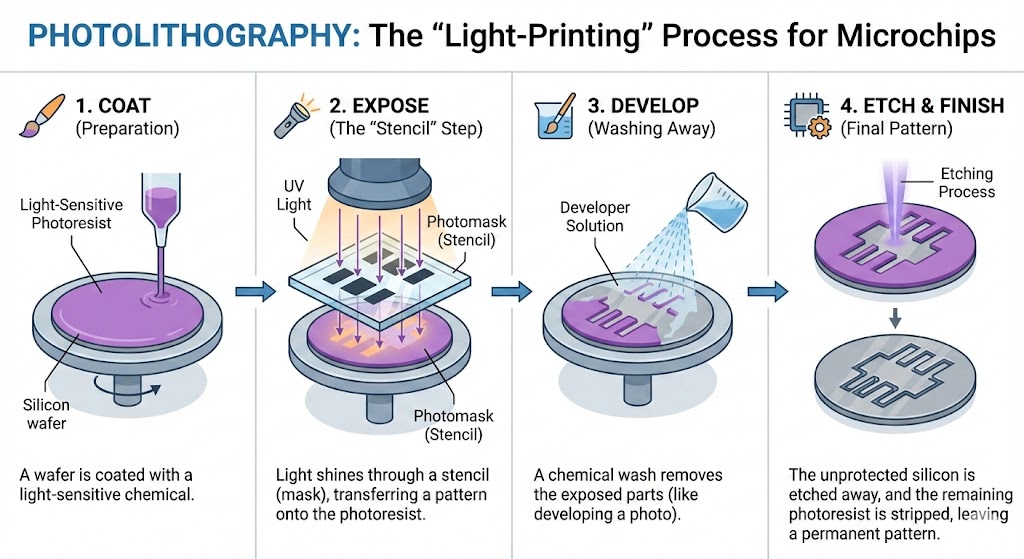
Here is a simple explanation of how the process works:
Step-by-step process:
- Wafer preparation
A thin silicon wafer is cleaned so it has no dust or particles. - Photoresist coating
A light-sensitive material called photoresist is spread evenly on the wafer. - Mask placement
A mask (a stencil with circuit patterns) is placed over the wafer. - Light exposure
Ultraviolet (UV) light shines through the mask. The light changes the photoresist in specific areas. - Development
The wafer is washed with a chemical solution. Some parts of the photoresist are removed, revealing the pattern. - Etching
The exposed areas are etched away to form permanent circuit paths. - Final cleaning
The remaining photoresist is removed, leaving behind the desired pattern.
This process can be repeated many times to build complex layers of circuits.
Why Is Photolithography Important?
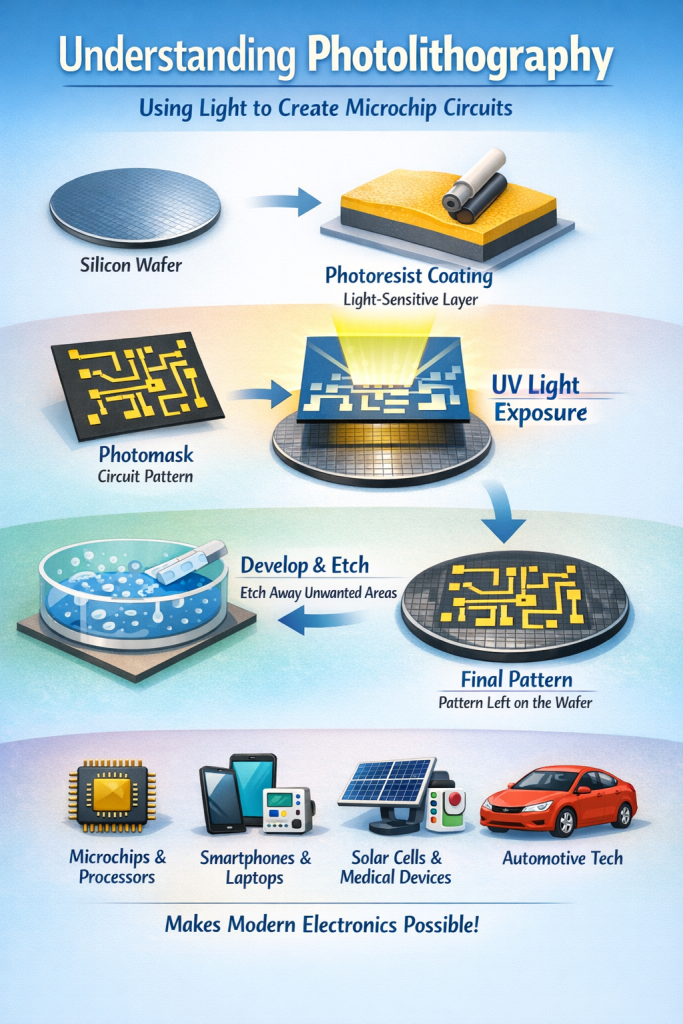
Photolithography is important because it makes modern technology possible. Without it, we would not have advanced electronics.
Here are the main reasons why it matters:
1. Enables Microchip Manufacturing
Photolithography is the foundation of making:
- CPUs and GPUs
- Memory chips
- Smartphones and laptops
- Smart TVs and gaming consoles
Every electronic device with a chip relies on this process.
2. Allows Extreme Miniaturization
Photolithography can create patterns that are only a few nanometers wide. This means:
- More circuits fit on a single chip
- Devices become faster and smaller
- Power consumption is reduced
This is why phones today are more powerful than old desktop computers.
3. Improves Performance and Speed
Smaller circuits mean:
- Faster data processing
- Better energy efficiency
- Less heat generation
As a result, devices run smoother and last longer.
4. Makes Mass Production Possible
Photolithography allows manufacturers to:
- Produce millions of identical chips
- Maintain high accuracy and consistency
- Reduce production costs
This makes advanced electronics affordable for everyday users.
5. Supports Innovation in Many Industries
Photolithography is not limited to electronics. It is also used in:
- Medical devices
- Solar panels
- Sensors and cameras
- Automotive electronics
It helps push innovation across multiple fields.
Simple Example to Understand Photolithography
Think of photolithography like using a stencil and spray paint.
- The stencil is the mask
- The paint is the light
- The surface is the silicon wafer
Only certain areas get painted, creating a clear pattern. Photolithography works in a similar way, but on a microscopic level.
Key Takeaways
Photolithography is one of the most important processes in modern manufacturing. It allows us to create tiny, powerful, and reliable electronic components that power our digital world.
From smartphones and laptops to medical equipment and electric cars, photolithography is working behind the scenes to make technology faster, smaller, and smarter.
 WEBRONAQ.COM