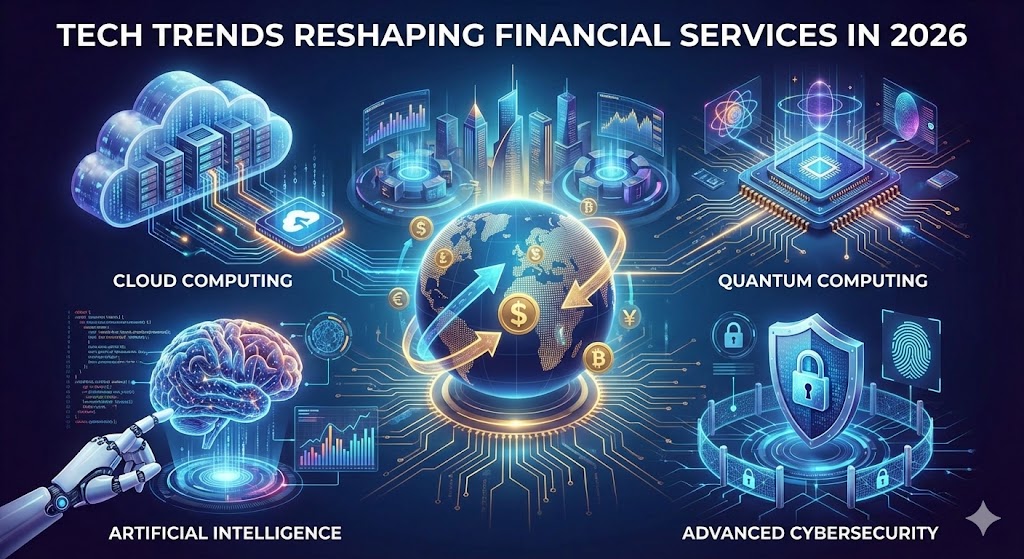
The financial services industry is changing faster than ever. Banks, fintech startups, insurers, and investment firms are no longer just about money—they are now technology-driven organizations. In 2026, four major technology trends are leading this transformation: cloud computing, artificial intelligence (AI), quantum computing, and advanced cybersecurity.
These technologies are not future concepts anymore. They are already shaping how financial institutions operate, compete, and protect customers. Let’s break down each trend in simple terms and understand why it matters.
Cloud Computing: The Backbone of Modern Finance
Cloud computing means storing data and running software on remote servers instead of local computers or in-house data centers. In finance, this shift has been massive.
Why cloud matters in 2026
Financial institutions are using cloud platforms like Amazon Web Services, Microsoft Azure, and Google Cloud to:
- Scale services quickly during high demand
- Launch new digital products faster
- Reduce infrastructure costs
- Improve system reliability
For example, mobile banking apps today handle millions of users at once. Cloud systems automatically adjust resources so apps don’t crash during peak hours.
What this means for customers
- Faster app performance
- Fewer service outages
- Quicker rollout of new features
Cloud computing has become the foundation on which all other financial technologies are built.
Artificial Intelligence: Smarter, Faster Financial Decisions
Artificial intelligence allows machines to learn from data and make decisions without being explicitly programmed. In simple terms, AI helps computers “think” more like humans—only faster.
How AI is used in finance
In 2026, AI is deeply embedded across financial services:
- Fraud detection: AI spots unusual transactions in real time
- Credit scoring: Machine learning evaluates risk more accurately
- Customer support: AI chatbots handle routine queries 24/7
- Investment advice: Robo-advisors analyze markets and portfolios
Organizations such as OpenAI and IBM have played a major role in advancing AI systems used by banks and fintech firms.
Simple definition
Machine learning is a type of AI where systems improve by learning from past data instead of following fixed rules.
Why AI is a game-changer
AI reduces human error, speeds up decisions, and helps institutions personalize services for millions of customers at once.
Quantum Computing: Redefining Financial Power
Quantum computing is one of the most complex—and powerful—technologies emerging in finance.
What is quantum computing?
Traditional computers use bits (0 or 1). Quantum computers use qubits, which can be both at the same time. This allows them to process massive calculations far faster than normal computers.
Financial applications in 2026
Although still early-stage, quantum computing is being tested for:
- Portfolio optimization
- Risk modeling
- Market simulation
- Complex derivatives pricing
Companies like IBM Quantum are working with financial institutions to explore real-world use cases.
Why it matters
Problems that take today’s computers days—or weeks—to solve could take minutes with quantum systems. This could completely change how financial strategies are built.
Advanced Cybersecurity: Protecting Trust in a Digital World
As financial services become more digital, cyber threats grow more sophisticated. In 2026, cybersecurity is no longer just an IT issue—it’s a business priority.
Key cybersecurity trends
Financial institutions now rely on:
- AI-powered threat detection
- Biometric authentication (fingerprints, facial recognition)
- Zero-trust security models
- Quantum-resistant encryption
Simple definition
Zero trust means no user or device is trusted automatically—even inside the network.
Why cybersecurity is critical
A single data breach can destroy customer trust overnight. Advanced cybersecurity ensures:
- Customer data stays safe
- Transactions remain secure
- Regulatory requirements are met
Security is now built into every layer of financial technology.
What This Means for You
The financial services industry of 2026 looks very different from just a few years ago. Cloud computing enables speed and scale. AI delivers intelligence and personalization. Quantum computing opens new frontiers of possibility. Advanced cybersecurity protects it all.
For consumers, this means better digital experiences and stronger protection. For businesses, it means new opportunities—and new responsibilities—to innovate wisely.
If you’re interested in building smarter financial skills, improving communication, or exploring business opportunities in a tech-driven world, you may find valuable insights in my collection of books on personal development and business strategy available on Apple Books.
 WEBRONAQ.COM