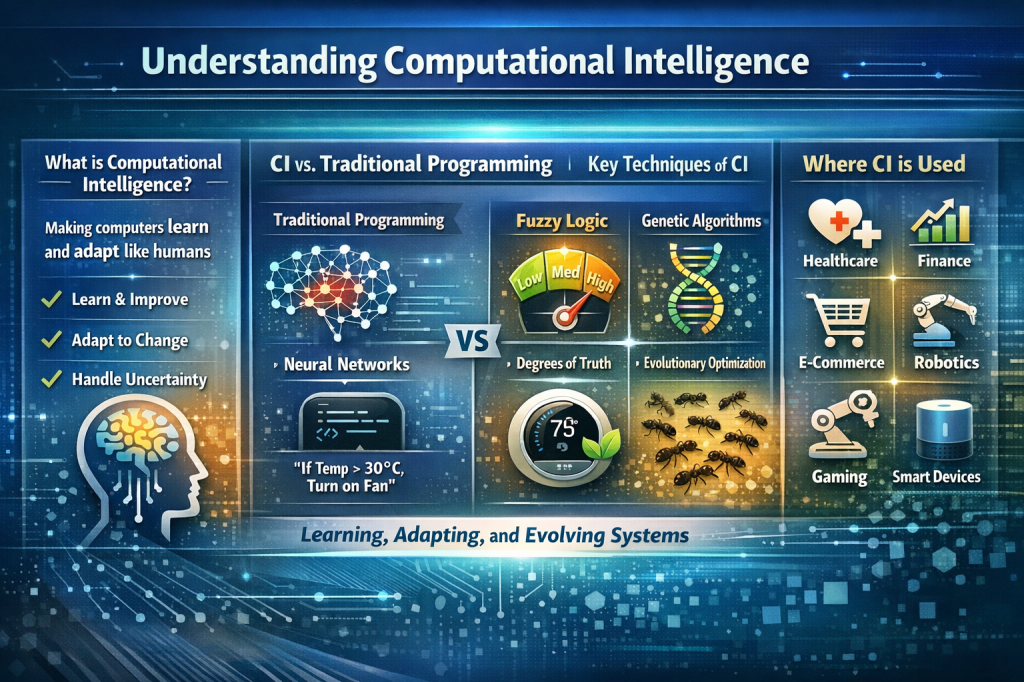
Computational Intelligence (CI) sounds like a complex, technical term—but at its core, it’s about making computers smarter in a human-like way.
Instead of following strict, pre-written rules, computational intelligence allows machines to learn, adapt, and make decisions when situations are uncertain, messy, or constantly changing—just like humans do in real life.
Let’s break it down step by step, using simple language and real-world examples.
What Is Computational Intelligence?
Computational Intelligence is a branch of artificial intelligence that focuses on building systems that can:
- Learn from experience
- Adapt to new situations
- Handle uncertainty and incomplete information
- Improve their performance over time
In simple terms, it teaches computers how to think flexibly instead of mechanically.
👉 What is artificial intelligence (AI)?
AI is the broader field of making machines perform tasks that normally require human intelligence, such as learning, reasoning, and problem-solving.
Computational Intelligence is a subset of AI that emphasizes learning and adaptation rather than hard-coded logic.
How Computational Intelligence Is Different from Traditional Programming
To understand CI, it helps to compare it with old-school programming.
Traditional Programming
- Humans write exact rules
- Computers follow those rules strictly
- Works well when everything is predictable
Example:
“If temperature > 30°C, turn on the fan.”
Computational Intelligence
- The system learns patterns on its own
- Rules are not fixed in advance
- Works well in complex, unpredictable environments
Example:
A smart thermostat that learns your habits and adjusts temperature automatically.
Core Techniques Used in Computational Intelligence
Computational Intelligence is not a single method. It’s a collection of approaches inspired by nature, biology, and human reasoning.
1. Neural Networks
👉 What is a neural network?
A neural network is a system inspired by the human brain that learns patterns by processing large amounts of data.
Real-life example:
- Face recognition on smartphones
- Voice assistants understanding speech
Neural networks improve with experience—just like humans learning from practice.
2. Fuzzy Logic
👉 What is fuzzy logic?
Fuzzy logic allows machines to think in degrees rather than strict yes/no decisions.
Instead of saying:
- “Hot” or “Not Hot”
It says:
- “Slightly hot,” “very hot,” or “extremely hot”
Real-life example:
- Washing machines adjusting water levels
- Air conditioners controlling room temperature smoothly
3. Genetic Algorithms
👉 What is a genetic algorithm?
A genetic algorithm is a problem-solving method inspired by natural evolution, using concepts like mutation and selection.
How it works (simplified):
- Generate many possible solutions
- Keep the best ones
- Mix and improve them
- Repeat until the best solution appears
Real-life example:
- Optimizing delivery routes
- Designing efficient airplane wings
4. Swarm Intelligence
👉 What is swarm intelligence?
Swarm intelligence is inspired by how groups of animals—like ants or birds—work together without a leader.
Real-life example:
- Traffic signal optimization
- Robot swarms in warehouses
- Crowd behavior analysis
Where Computational Intelligence Is Used Today
Computational Intelligence is already shaping many industries—even if you don’t notice it.
Common Applications
- Healthcare: Disease prediction and medical imaging
- Finance: Fraud detection and algorithmic trading
- E-commerce: Product recommendations
- Gaming: Smarter, adaptive opponents
- Robotics: Self-learning machines
- Smart devices: Voice assistants and smart homes
Every time a system “learns” from your behavior, CI is likely involved.
Why Computational Intelligence Matters
The real world is messy. Data is incomplete. People behave unpredictably. Traditional programming struggles with this—but CI thrives in it.
Key Benefits
- Learns from data instead of rules
- Adapts to new conditions
- Handles uncertainty gracefully
- Improves over time
This is why CI is essential for modern technologies like self-driving cars, recommendation engines, and intelligent assistants.
Computational Intelligence vs Machine Learning
People often confuse these terms, so here’s a quick clarification.
👉 What is machine learning?
Machine learning is a technique where computers learn patterns from data.
Relationship:
- Machine learning is a part of computational intelligence
- Computational intelligence includes machine learning plus fuzzy logic, genetic algorithms, and swarm intelligence
Think of CI as a toolbox, and machine learning as one powerful tool inside it.
What This Means for You
Computational Intelligence is not just for scientists or programmers.
If you:
- Use smartphones
- Shop online
- Stream videos
- Use navigation apps
You are already benefiting from it.
As CI continues to evolve, it will:
- Automate more decisions
- Personalize experiences
- Create new career opportunities
Understanding the basics now puts you ahead of the curve.
If you’re interested in learning how intelligent systems, decision-making, and human behavior connect with business and personal growth, you may find my books on technology, communication, and self-improvement helpful. You can explore them on my Apple Books author page.
 WEBRONAQ.COM