Artificial Intelligence (AI) is everywhere today—from chatbots and recommendation systems to self-driving cars. But behind all these tools is a powerful concept many people don’t fully understand: AI reasoning.
In simple terms, AI reasoning is how an AI system thinks through a problem and decides what to do next. It’s what allows machines to go beyond following fixed instructions and instead make informed decisions.
Let’s break it down step by step, in plain language.
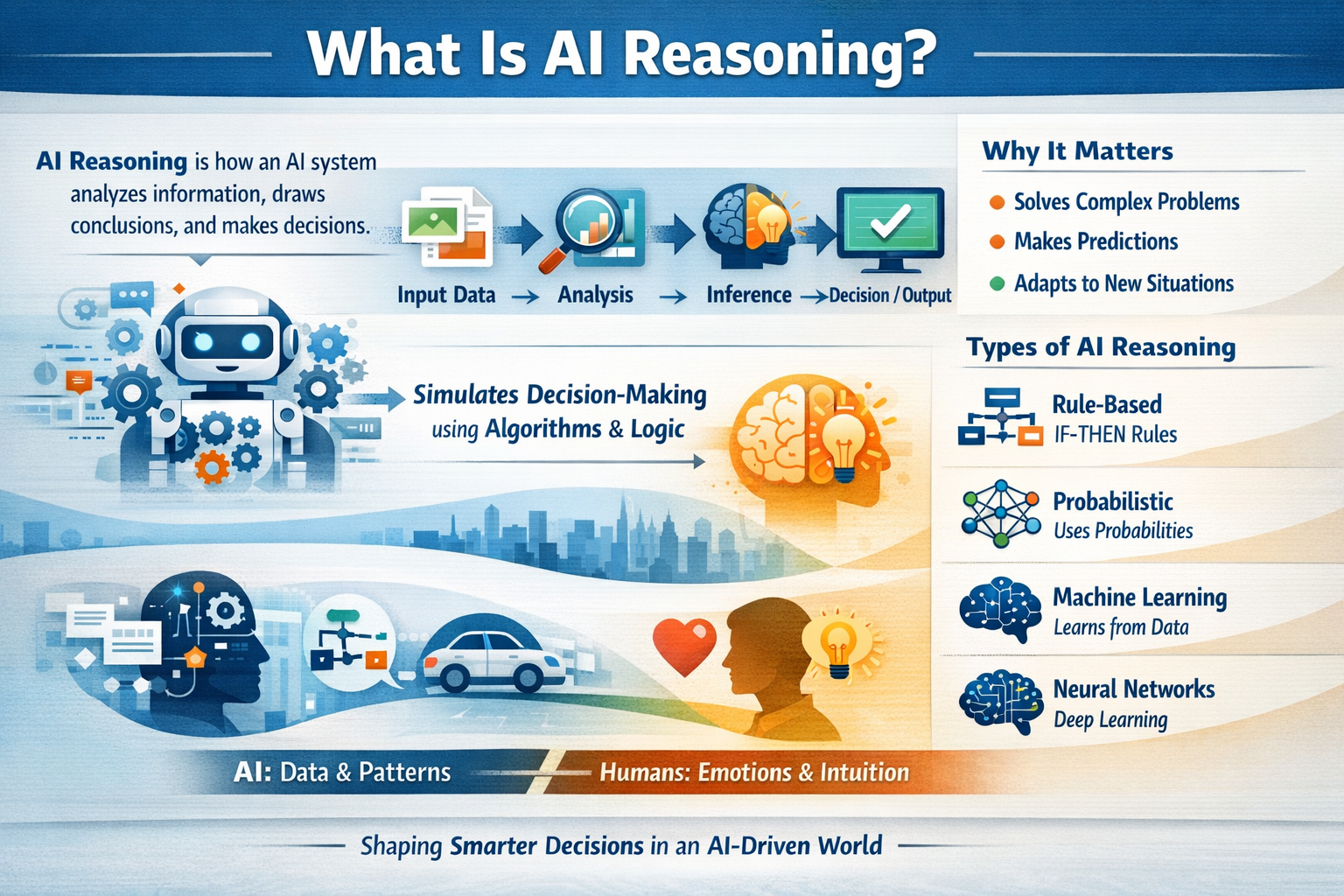
AI reasoning is the ability of an artificial intelligence system to analyze information, draw conclusions, and make decisions—similar to how humans reason.
👉 What is reasoning?
Reasoning is the mental process of using facts, rules, or patterns to reach a conclusion. For humans, this happens naturally. For AI, it’s done using algorithms, data, and models.
Instead of “thinking” like a human brain, AI uses mathematics and logic to simulate decision-making.
Why AI Reasoning Matters
Without reasoning, AI would be nothing more than a calculator.
AI reasoning allows systems to:
- Solve complex problems
- Make predictions
- Adapt to new situations
- Explain why a decision was made (in some systems)
For example:
- A navigation app reasons about traffic data to suggest the fastest route.
- A medical AI reasons about symptoms to help identify diseases.
- A chatbot reasons about your question to give a useful reply.
How AI Reasoning Works (In Simple Terms)
AI reasoning usually follows a few basic steps:
- Input – The AI receives data (text, images, numbers, etc.)
- Analysis – It processes the data using learned patterns or rules
- Inference – It draws conclusions from that data
- Decision or Output – It provides an answer, action, or recommendation
👉 What is inference?
Inference is the process of reaching a conclusion based on evidence and reasoning. In AI, it means predicting the most likely answer based on data.
Main Types of AI Reasoning
Not all AI reasons the same way. Here are the most common types, explained simply.
1. Rule-Based Reasoning
This is the oldest and simplest form.
- Uses if–then rules
- Example: If temperature > 38°C, then fever = yes
👉 What is rule-based AI?
Rule-based AI follows predefined instructions written by humans.
Pros: Predictable and easy to understand
Cons: Can’t adapt well to new situations
2. Logical Reasoning
Logical reasoning uses formal logic, similar to math proofs.
Example:
- All humans need oxygen
- John is human
- Therefore, John needs oxygen
This type is often used in expert systems and planning tools.
3. Probabilistic Reasoning
Real life is uncertain, and AI must deal with that.
👉 What is probabilistic reasoning?
It means making decisions based on likelihoods instead of absolute certainty.
Example:
- “There is an 85% chance this email is spam.”
This is widely used in:
- Weather forecasting
- Medical diagnosis
- Risk analysis
4. Machine Learning–Based Reasoning
This is the most common form today.
👉 What is machine learning?
Machine learning is when AI learns patterns from data instead of being explicitly programmed.
The AI:
- Studies large amounts of data
- Learns patterns
- Uses those patterns to reason in new situations
For example:
- Netflix recommends shows based on what similar users liked
- Fraud detection systems reason about unusual transactions
5. Neural Network Reasoning (Deep Learning)
Modern AI systems, including those developed by organizations like OpenAI, use deep neural networks.
👉 What is a neural network?
It’s a system inspired by the human brain that processes information through layers of connected “neurons.”
This type of reasoning is powerful but often harder to explain—sometimes called a “black box.”
AI Reasoning vs Human Reasoning
While AI reasoning is impressive, it’s not the same as human thinking.
Key differences:
- Humans use emotions, intuition, and common sense
- AI relies only on data and patterns
- Humans understand meaning deeply
- AI understands statistically
AI doesn’t “know” things—it calculates probabilities based on what it has learned.
Real-World Examples of AI Reasoning
You interact with AI reasoning every day, often without realizing it:
- Search engines decide which results are most relevant
- Voice assistants reason about your intent
- Credit scoring systems assess risk
- Autonomous vehicles reason about obstacles and traffic rules
Each of these systems takes in data, reasons through it, and produces an outcome.
Limitations of AI Reasoning
Despite its power, AI reasoning has limits:
- It depends heavily on data quality
- It can inherit biases from training data
- It lacks true understanding or consciousness
- Complex reasoning can be difficult to explain
This is why human oversight is still essential.
What This Means for You
AI reasoning is shaping how we work, learn, and make decisions.
Understanding it helps you:
- Use AI tools more effectively
- Trust AI systems appropriately (not blindly)
- Prepare for an AI-driven future
Whether you’re a student, professional, or entrepreneur, knowing how AI reasons gives you a real advantage.
If you’re interested in improving how you think, communicate, and adapt in a tech-driven world, you may also enjoy exploring books on personal development and digital skills by this author, which connect human reasoning with modern technology in a practical way.