Artificial intelligence often feels mysterious, especially when you hear terms like machine learning, neural networks, or subsymbolic AI. If you’re new to AI, don’t worry—this guide breaks everything down in clear, simple language.
By the end of this article, you’ll understand what subsymbolic AI is, how it works, and why it matters so much in today’s technology.
Understanding Subsymbolic AI in Plain English
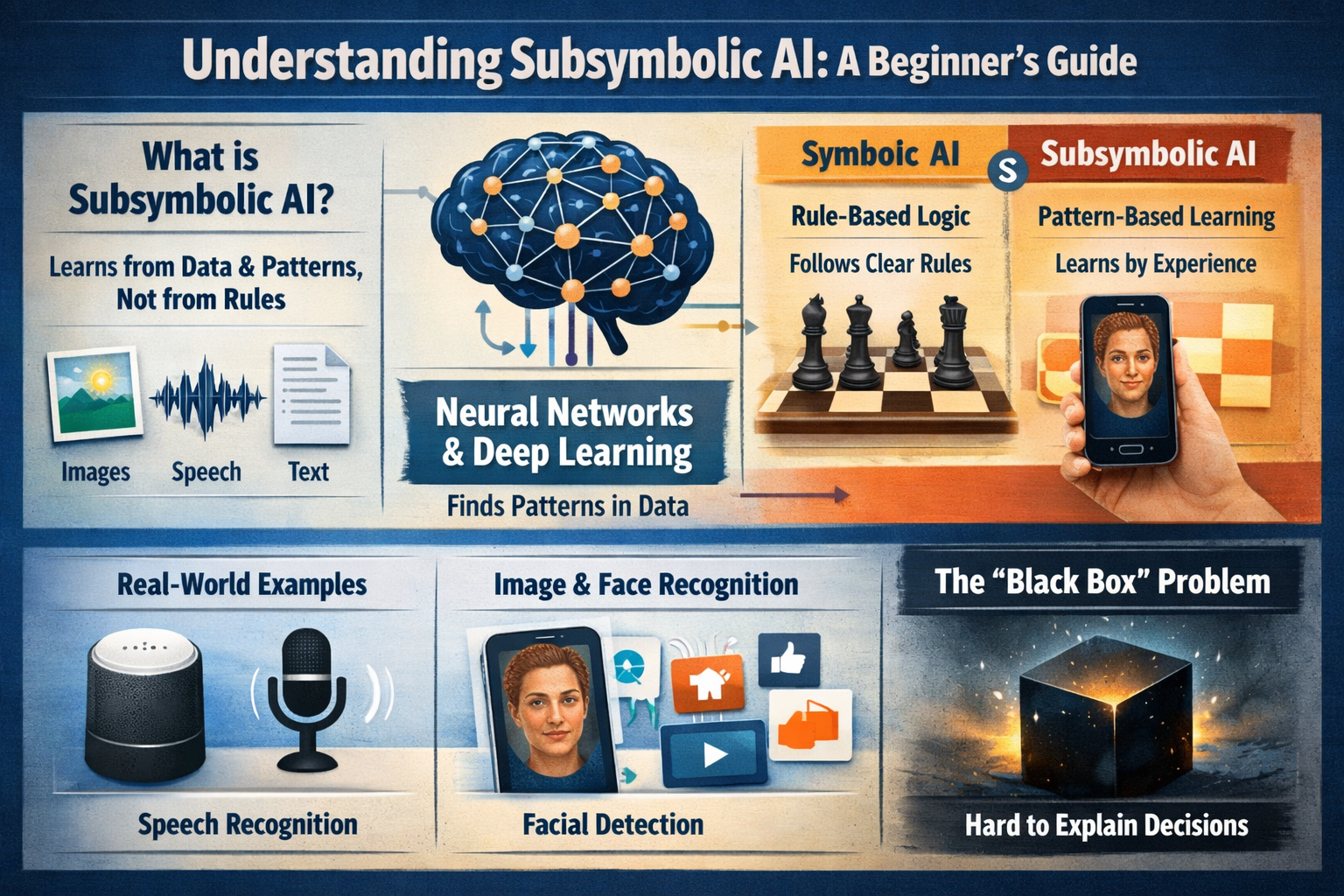
Subsymbolic AI is a type of artificial intelligence that learns patterns from data instead of following clearly written rules.
👉 What is Subsymbolic AI?
It’s an AI approach where machines learn from examples—like images, sounds, or text—rather than from human-defined symbols or logic rules.
Think of it like this:
- Humans often explain things using rules and words
- Subsymbolic AI learns the feel of things by experience, much like humans do subconsciously
This makes it especially good at tasks that are hard to describe with exact rules.
How Subsymbolic AI Works
Instead of saying “If A happens, then do B”, subsymbolic AI works by adjusting millions (or billions) of tiny numbers inside a model until it gets good results.
The most common tools behind subsymbolic AI include:
- Neural networks
- Deep learning models
- Machine learning algorithms
👉 What is a neural network?
A neural network is a computer system inspired by the human brain, made of connected layers that process information and learn from mistakes.
The AI doesn’t “understand” concepts in words—it understands them as mathematical patterns.
Subsymbolic AI vs Symbolic AI
To really understand subsymbolic AI, it helps to compare it with symbolic AI.
Symbolic AI (Rule-Based Thinking)
- Uses clear rules and symbols
- Example: Chess programs using logic trees
- Easy to explain why a decision was made
- Struggles with messy, real-world data
Subsymbolic AI (Pattern-Based Learning)
- Learns from examples, not rules
- Example: Face recognition on your phone
- Excellent with images, speech, and language
- Hard to explain how decisions are made
In short:
- Symbolic AI thinks in rules
- Subsymbolic AI learns by experience
Real-World Examples of Subsymbolic AI
You already interact with subsymbolic AI every day—often without realizing it.
1. Voice Assistants
When you speak to your phone or smart speaker, subsymbolic AI:
- Converts sound waves into patterns
- Matches them to learned speech models
- Understands intent, even with accents
2. Image and Face Recognition
Your phone unlocks using:
- Pixel patterns
- Learned facial features
- Probability-based matching
No rule says “two eyes + one nose = face”—the AI just learns from millions of examples.
3. Recommendation Systems
Platforms like video and shopping apps use subsymbolic AI to:
- Learn your preferences
- Predict what you might like
- Improve recommendations over time
Why Subsymbolic AI Is So Powerful
Subsymbolic AI shines where human rules fall apart.
Key Strengths
- Handles noisy, real-world data
- Learns continuously from new information
- Performs well with complex tasks like vision and language
- Scales to massive datasets
This is why modern breakthroughs in AI mostly rely on subsymbolic approaches, including systems developed by companies like OpenAI.
The Biggest Limitation of Subsymbolic AI
Despite its power, subsymbolic AI has a major weakness.
👉 The “black box” problem
It’s often hard—or impossible—to explain why the AI made a specific decision.
For example:
- Why was a loan rejected?
- Why did the AI misidentify an image?
- Why did it recommend one option over another?
This lack of transparency is a serious concern in areas like healthcare, law, and finance.
Can Subsymbolic and Symbolic AI Work Together?
Yes—and this is where the future is heading.
Researchers are developing hybrid AI systems that combine:
- Symbolic AI’s clear reasoning
- Subsymbolic AI’s learning ability
👉 What is hybrid AI?
It’s an approach that mixes rule-based logic with data-driven learning to get the best of both worlds.
This could lead to AI that is:
- More explainable
- More trustworthy
- More human-like in reasoning
Why Subsymbolic AI Matters for the Future
Subsymbolic AI is the foundation of modern AI progress. Without it, we wouldn’t have:
- Accurate speech recognition
- Self-driving car perception
- Realistic image generation
- Natural language understanding
As computing power and data continue to grow, subsymbolic AI will become even more capable—and more embedded in everyday life.
What This Means for You
You don’t need to be a programmer to understand subsymbolic AI. What matters is knowing:
- It learns from data, not rules
- It powers most modern AI tools
- It’s powerful but not always transparent
If you’re interested in learning how AI, digital skills, and modern systems shape income, communication, and personal growth, you may find helpful insights in my books on business and personal development.
Understanding concepts like subsymbolic AI helps you stay informed—and confident—in a world increasingly shaped by intelligent systems.