Artificial Intelligence (AI) is no longer just a futuristic concept—it’s actively shaping the way businesses, governments, and even our daily lives make decisions. But what does AI decision-making actually mean, and how does it work? Let’s break it down step by step.
Understanding AI Decision-Making
AI decision-making refers to the process where computer systems use data, algorithms, and logic to make choices or recommendations, often mimicking human reasoning. Unlike humans, AI can analyze vast amounts of data in seconds, spotting patterns and trends that might go unnoticed.
What is an algorithm?
An algorithm is a set of rules or instructions that a computer follows to solve a problem or make a decision.
For example, when you use a streaming service, AI recommends shows you might like based on what you’ve watched before. That’s AI decision-making in action—it analyzes data (your viewing habits) and chooses the best option for you.
How AI Makes Decisions
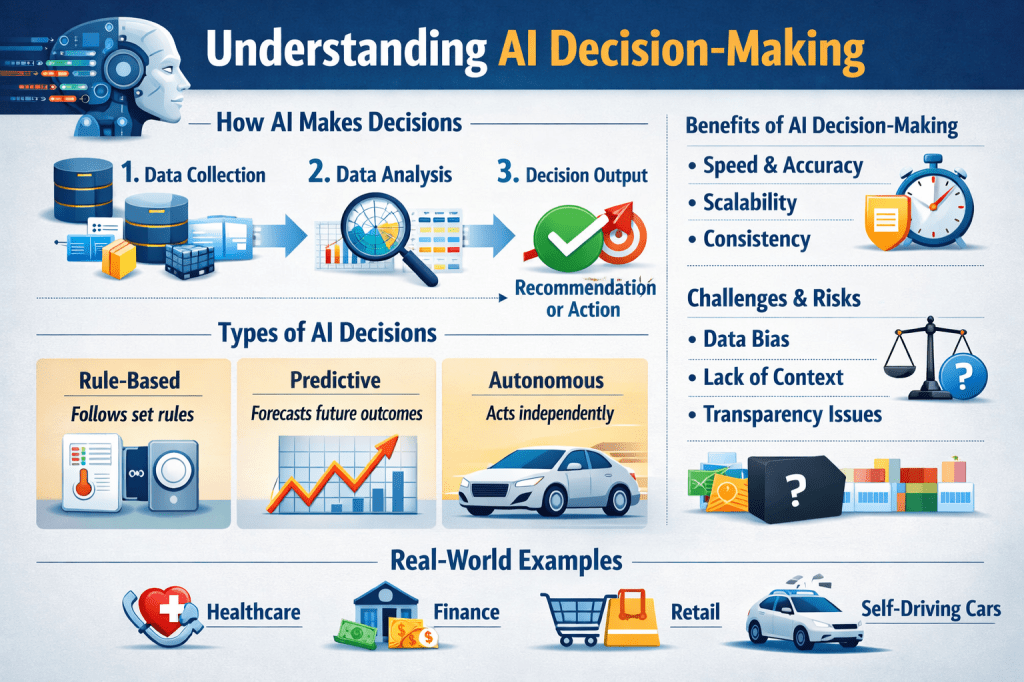
AI decision-making can be understood in three main steps:
- Data Collection
AI needs information to make decisions. This data can come from various sources, such as sensors, databases, social media, or financial records. - Data Analysis
AI algorithms process the collected data to identify patterns, trends, and relationships. This might involve statistical models, machine learning, or deep learning techniques. - Decision Output
Finally, AI provides a recommendation or makes an autonomous choice. This output can be a simple yes/no answer, a ranking of options, or even complex predictions like weather forecasts or stock market trends.
Types of AI Decision-Making
AI systems vary in complexity, and their decision-making can fall into several categories:
- Rule-Based Decisions
These follow pre-set rules. For example, a thermostat turning on the heat when the temperature drops below 68°F is a simple AI decision. - Predictive Decisions
AI predicts future outcomes based on historical data. For example, banks use AI to assess credit risk before approving loans. - Autonomous Decisions
Advanced AI can make decisions without human intervention. Self-driving cars deciding when to stop or change lanes are examples of autonomous decision-making.
Benefits of AI Decision-Making
AI decision-making offers many advantages:
- Speed: AI can process data and make decisions much faster than humans.
- Accuracy: AI reduces human error by relying on data-driven analysis.
- Scalability: AI can analyze huge datasets that would be impossible for humans to handle.
- Consistency: AI follows rules and algorithms consistently without bias caused by fatigue or emotion.
Challenges and Risks
Despite its benefits, AI decision-making is not perfect. Some challenges include:
- Bias in Data: If the data is biased, AI decisions will reflect that bias.
- Lack of Context: AI might make technically correct decisions that are socially or ethically questionable.
- Transparency: Many AI systems, especially deep learning models, act as a “black box,” making it hard to understand why a decision was made.
For example, if an AI denies a loan application, it may be unclear which factors influenced that decision, even to experts.
Real-World Examples
AI decision-making is already transforming industries:
- Healthcare: AI helps doctors diagnose diseases by analyzing medical images and patient histories.
- Finance: AI evaluates investment opportunities and detects fraudulent transactions.
- Retail: AI predicts what products you might want to buy next based on your shopping patterns.
- Transportation: AI powers self-driving cars, optimizing routes and traffic management.
Key Takeaways
AI decision-making is the process where intelligent systems use data and algorithms to make choices. While it offers speed, accuracy, and efficiency, it also comes with challenges like bias and lack of transparency. Understanding how AI makes decisions is essential as it becomes more integrated into everyday life—from the apps we use to the services we rely on.
To explore more practical insights on decision-making and personal development, check out my books on personal growth and business strategies.
 WEBRONAQ.COM