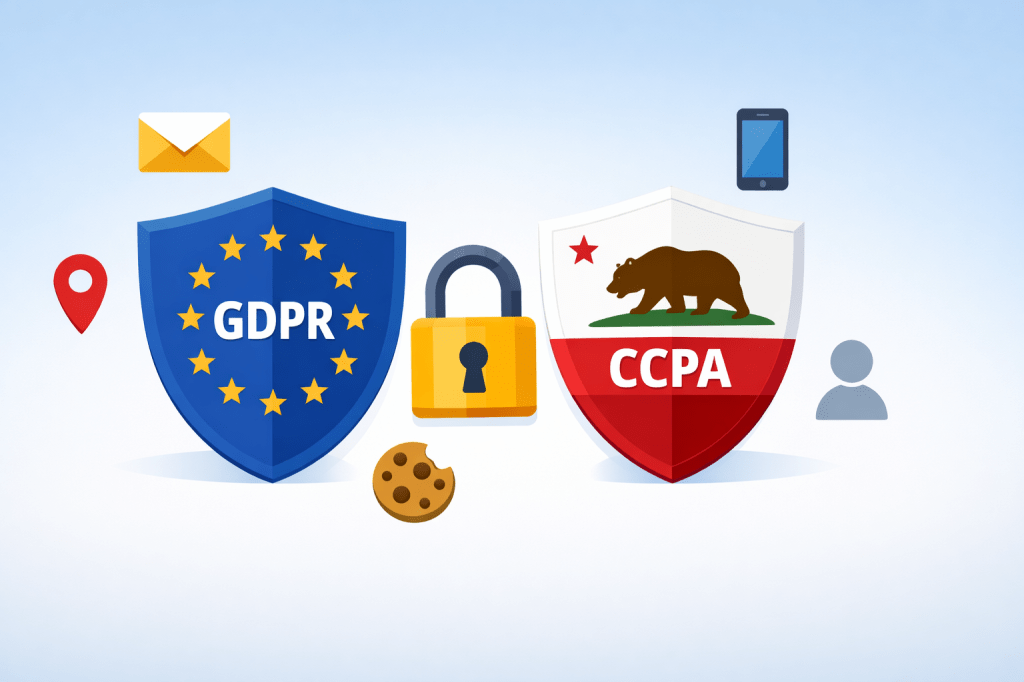
If you run a website, sell products online, or collect any kind of user data, you have probably heard the terms GDPR and CCPA thrown around. These are two of the most important privacy regulations in the world, and they directly affect how you collect, store, and use people’s personal information. The problem is, most explanations of these laws read like they were written by lawyers for lawyers. I am Shafaat Ali, and in this article, I will break down GDPR and CCPA in plain, simple language so you can understand what they mean, how they differ, and what you need to do to stay compliant in 2026.
What Is GDPR?
GDPR stands for General Data Protection Regulation. It is a privacy law that was introduced by the European Union and went into effect in May 2018. Its purpose is simple: to give people in the EU more control over their personal data and to hold businesses accountable for how they handle that data.
Personal data under GDPR includes anything that can identify a person. This covers obvious things like names, email addresses, and phone numbers. But it also includes less obvious things like IP addresses, device IDs, location data, and even cookie identifiers. If a piece of data can be used, directly or indirectly, to identify someone, GDPR applies to it.
Here is the key thing about GDPR: it does not just apply to companies based in Europe. If your business is located in the United States, Pakistan, or anywhere else in the world, but you collect data from people in the EU, you must comply with GDPR. The law follows the user, not the business.
GDPR is built on a consent-first model. This means you must get clear, explicit permission from a user before you collect their data. You cannot pre-check consent boxes. You cannot bury consent in a long terms-of-service page that nobody reads. The user must actively agree, and they must be told exactly what data you are collecting and why.
If your business violates GDPR, the penalties are severe. Fines can reach up to 20 million euros or four percent of your company’s global annual revenue, whichever is higher. Since 2018, GDPR fines have exceeded 5.88 billion euros globally. Major companies like Meta and TikTok have faced penalties in the hundreds of millions of euros for violations related to consent manipulation and illegal data transfers.
What Is CCPA?
CCPA stands for the California Consumer Privacy Act. It went into effect in January 2020 and was later strengthened by the California Privacy Rights Act, known as CPRA. Together, these laws give California residents greater control over their personal information.
While GDPR requires businesses to get consent before collecting data, CCPA takes a different approach. Under CCPA, businesses can collect data, but they must give consumers the right to opt out. Specifically, consumers have the right to know what data is being collected, the right to request deletion of their data, and the right to opt out of the sale or sharing of their personal information.
CCPA applies to for-profit businesses that meet certain thresholds, such as having annual gross revenue above a specific amount or processing personal data of a large number of California residents. The law applies regardless of where the business is physically located. If you handle data from California residents and meet the criteria, you must comply.
The penalties under CCPA are smaller per incident compared to GDPR, with fines of up to 2,500 dollars per unintentional violation and 7,500 dollars per intentional violation. However, these add up quickly when you consider that each affected consumer counts as a separate incident. Consumers also have the right to sue businesses directly in the event of a data breach.
In 2026, CCPA compliance has become more demanding. New regulations that took effect on January 1, 2026, introduced mandatory risk assessments for high-risk data practices such as targeted advertising and the processing of sensitive personal information. Businesses must now also recognize and honor opt-out preference signals, meaning if a user’s browser sends a global privacy control signal, your website must automatically respect that choice. Additionally, businesses are required to confirm to users that their opt-out request has been processed, through visible indicators like a message or a toggle showing that tracking has been disabled.
How GDPR and CCPA Are Different
The biggest difference is the consent model. GDPR requires opt-in consent, meaning you must ask for permission before collecting data. CCPA uses an opt-out model, meaning you can collect data but must allow users to stop the sale or sharing of their information.
Another difference is scope. GDPR applies to any organization handling EU residents’ data, regardless of size. CCPA only applies to businesses that meet specific revenue or data-processing thresholds. GDPR also covers a broader range of rights, including the right to data portability, which means users can request their data in a format they can take to another service.
Enforcement differs as well. GDPR is enforced by data protection authorities in each EU member state, while CCPA is enforced by the California Attorney General’s office and the California Privacy Protection Agency, which rebranded to CalPrivacy.
Why This Matters for Your Digital Marketing
If you use tools like Google Analytics, Google Ads, or any tracking pixel on your website, privacy regulations directly affect your marketing operations. Every tag or pixel that collects user data must comply with these laws.
This is where tools like Google Tag Manager become essential. GTM allows you to control exactly when and how your tracking codes fire. For instance, you can configure GTM so that your analytics and advertising tags only activate after a user has given consent. GTM now integrates with Google’s Consent Mode, making this process much easier. If you are not already using GTM, I recommend reading my detailed guide on what Google Tag Manager is and how to use it in your digital marketing strategy. It covers everything from setup to server-side tagging and privacy compliance.
Practical Steps to Stay Compliant
First, audit your website to understand what data you are collecting and which tools are doing the collecting. Second, implement a consent management platform that presents clear options to your users and respects their choices. Third, use a tag management solution like GTM to centralize your tracking and ensure tags only fire when appropriate consent has been granted. Fourth, update your privacy policy so it clearly explains what data you collect, why you collect it, who you share it with, and how users can exercise their rights. Fifth, stay informed because privacy regulations are evolving rapidly. In 2026 alone, multiple U.S. states including Kentucky, Indiana, and Oregon have implemented new or amended privacy laws, and the EU is working on simplification proposals to reduce the compliance burden on smaller businesses while keeping protections strong.
Key Takeaways
GDPR and CCPA are not obstacles to your business. They are frameworks designed to build trust between you and your users. When people know their data is being handled responsibly, they are more likely to engage with your brand, share their information willingly, and become loyal customers. Understanding these regulations is not optional in 2026. It is a fundamental part of running a responsible, successful business.
For more practical guides on digital marketing, data privacy, and building real-world skills, you can explore my books on Apple Books. You can also subscribe to my YouTube channel for video tutorials. If you would like to connect, find me on LinkedIn or X.
 WEBRONAQ.COM