An 87-Year-Old Conjecture Falls — Here’s What Happened
On July 20, 2026, mathematician Levent Alpoge, a number theorist at Anthropic and former Harvard Society of Fellows Junior Fellow, announced on X that he had found a counterexample to the Jacobian Conjecture — a problem posed in 1939 that has resisted every serious attempt at resolution since. Alpoge credited Claude Fable 5 as a collaborator in the work, which he described as having been done during the World Cup final.
The result, if it survives formal peer review, settles one of the most stubborn open questions in algebraic geometry and polynomial dynamics. It also marks a striking moment for AI-assisted mathematical research: a working mathematician and a language model, together, appear to have cracked a problem that stumped generations of specialists.
What the Jacobian Conjecture Actually Says
The conjecture originates with German mathematician Ott-Heinrich Keller, who posed it in 1939. The question is deceptively clean: if you have a polynomial map from n-dimensional complex space to itself — meaning each output coordinate is a polynomial in the input coordinates — and the determinant of its Jacobian matrix is a nonzero constant everywhere, must the map always have a polynomial inverse?
A Jacobian matrix collects all the partial derivatives of the map’s components. Its determinant measures, loosely, how much the map stretches or compresses small regions near each point. A nonzero constant determinant means that stretching factor never collapses to zero anywhere — the map is, in a precise sense, locally well-behaved everywhere. The conjecture asked whether that condition is enough to guarantee the map is globally invertible, with an inverse that is also a polynomial.
For over eight decades, no one could prove it was true, and no one could prove it was false.
Why Local Invertibility Is Not the Same as Global Invertibility
The heart of the conjecture lives in a gap that the inverse function theorem makes precise. That theorem tells us: if a map’s Jacobian determinant is nonzero at a particular point, then near that point the map is invertible — you can uniquely reverse it in a small neighborhood. What the theorem does not say is anything about the map’s behavior across all of complex space at once.
Think of it this way: a road that is locally straight at every single point can still loop back and cross itself globally. Local straightness, verified everywhere, does not rule out global crossings. The Jacobian Conjecture was essentially asking whether, for polynomial maps on complex space, local invertibility everywhere forces global invertibility. The counterexample says: no, it does not.
This local-to-global gap is one reason the problem resisted resolution for so long. Every tool that probes local behavior — derivatives, linearizations, Taylor expansions — is exactly the wrong kind of tool for ruling out global pathologies.
The Counterexample: One Map, Three Inputs, One Output
The counterexample Alpoge produced is an explicit polynomial map from C³ to C³ — from three-dimensional complex space to itself. Its Jacobian determinant is identically equal to negative 2, a nonzero constant, so it satisfies the conjecture’s premise exactly.
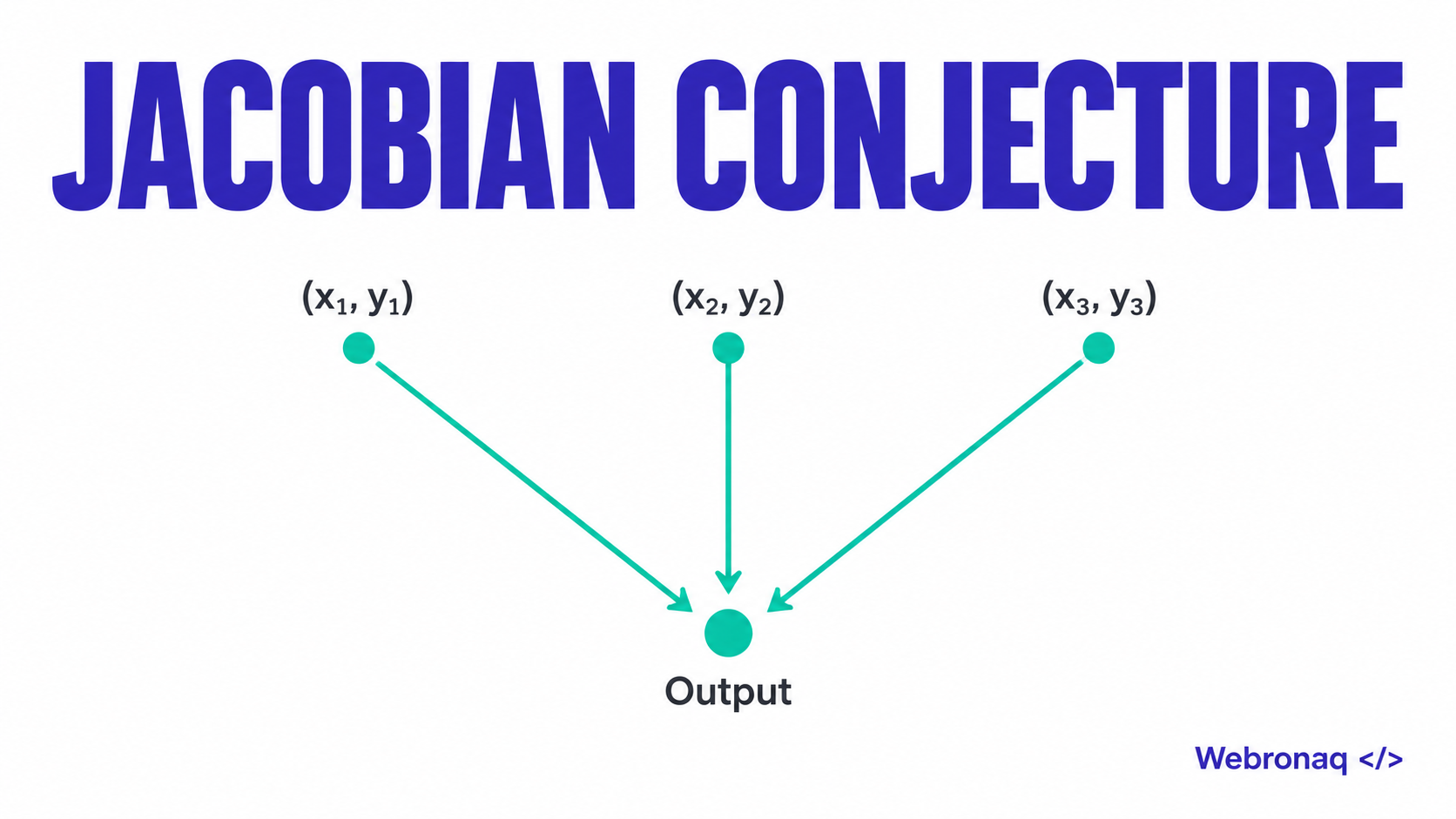
Despite that, the map is not injective. Three distinct input points — (0, 0, −1/4), (1, −3/2, 13/2), and (−1, 3/2, 13/2) — all map to the same output: (−1/4, 0, 0). A map that sends three different inputs to one output cannot have an inverse, polynomial or otherwise. The conjecture is false.
Multiple mathematicians independently checked the arithmetic using tools including Wolfram Alpha and SymPy, and a community verification preprint was noted by July 21, 2026, though its authorship and arXiv identifier were not confirmed in available sources. One Hacker News commenter noted the counterexample appears to be degree 7, which they described as surprisingly low given prior expectations — though that characterization comes from a single uncredentialed comment rather than a primary mathematical source.
What This Disproves — and What It Doesn’t
A counterexample in C³ is enough to settle the conjecture for all dimensions n ≥ 3: you can extend any three-variable counterexample to higher dimensions simply by appending identity coordinates, and the nonzero constant Jacobian property carries through. The Jacobian Conjecture, as a universal claim, is false.
The two-variable case — maps from C² to C² — remains open as of July 22, 2026. Discovering that the conjecture fails in three dimensions says nothing, by itself, about whether it might still hold in two. That question is now the surviving frontier of the original problem.
Formal journal peer review had not concluded as of July 22, 2026. The arithmetic verifications by independent mathematicians are encouraging, but a published counterexample to an 87-year-old conjecture will rightly face rigorous scrutiny before the mathematical community treats it as settled.
How Claude Fable 5 Contributed — and What We Don’t Know
Alpoge explicitly credited Claude Fable 5 as a collaborator in his announcement. That attribution is first-party testimony from the mathematician himself, and it is the basis for the widespread coverage of this result as an AI-assisted breakthrough.
Claude Fable 5 is Anthropic’s publicly available Mythos-class model, released on June 9, 2026. Anthropic launched it alongside a restricted sibling, Claude Mythos 5, which shares the same underlying capabilities but is available only to a limited set of partners through Project Glasswing. Fable 5 is the generally available model; Mythos 5 is not.
What cannot currently be independently verified is the division of work between Alpoge and the model. No prompt transcript, session log, or research notebook has been publicly released, so it is not possible to say which parts of the argument the model proposed, which it checked, or which it got wrong before arriving at something useful. As one independent analysis noted, the collaboration is reported but undocumented at the level of detail that would let an outside observer assess it.
Why This Conjecture Resisted Proof for So Long
The Jacobian Conjecture’s reputation for devouring careful mathematicians is well established. Over the decades, at least five published proofs turned out to contain errors — a track record unusual even for hard open problems, and a reason the mathematical community learned to approach claimed proofs with particular caution.
The problem also carried real prestige. Stephen Smale included it as Problem 16 on his 1998 list of Mathematical Problems for the Next Century, placing it alongside the Riemann Hypothesis and the Navier-Stokes existence and smoothness problem. That placement signaled community consensus that the conjecture was both deep and probably very difficult.
The structural difficulty is real. Polynomial maps can behave in globally complicated ways even when their local behavior is everywhere well-controlled. The tools of complex analysis and algebraic geometry provide many ways to study local structure, but ruling out global collisions — points where distinct inputs meet the same output — requires a different kind of argument entirely, and no one found one that worked.
What the Disproof Means for Mathematics and AI-Assisted Research
Fields Medalist Timothy Gowers, according to multiple secondary reports, described the result — assuming it holds up — as the first time an LLM had solved a well-known mathematical problem he had heard of outside his own area. That reaction, from a mathematician of Gowers’s standing, signals that the community is taking the result seriously even before formal peer review closes.
The deeper question the result raises is not whether AI can do mathematics — Alpoge did mathematics, and credited a model as a collaborator — but what the collaboration model looks like, and how it changes what is tractable. A working number theorist with deep expertise in the problem space, using a capable model as an interactive partner, found a counterexample to a problem that had defeated specialists for nearly ninety years. Whether that pattern generalizes, and what it implies for mathematical practice, is a question the community is only beginning to work through.
Some sources note that a confirmed disproof of the Jacobian Conjecture could have implications for related conjectures, including the Dixmier and Poisson conjectures, though the scope of those consequences depends on formal peer-reviewed analysis that had not been completed as of July 22, 2026.
The arithmetic of the counterexample has been checked, the announcement is public, and the mathematical community is actively reviewing the result. Whether it fully holds and what it implies beyond the conjecture itself will become clearer as peer review progresses. For now, it stands as one of the more striking results of 2026 — and a genuine data point in the ongoing conversation about what mathematicians and AI systems can accomplish together.
For clear video lessons on computer science, AI, and software engineering, subscribe to Webronaq on YouTube.
FAQ
Is the Jacobian Conjecture completely settled?
The conjecture is disproved for all dimensions n ≥ 3. The two-variable (n = 2) case remains open as of July 22, 2026. Formal peer review of the counterexample had not concluded at that date.
What does it mean for a polynomial map to have a constant Jacobian determinant?
The Jacobian determinant measures local stretching or compression at each point. A nonzero constant value means the map never collapses volume at any point — it is locally invertible everywhere. The conjecture asked whether that global local-invertibility forces global invertibility. The counterexample shows it does not, at least in three or more dimensions.
Did Claude Fable 5 independently discover the counterexample?
Alpoge credited Claude Fable 5 as a collaborator, but no transcript or session log has been released. The precise division of work between the mathematician and the model cannot be independently verified from publicly available information.
Sources
- Levent Alpoge — announcement post, July 20, 2026 (via XCancel) — Levent Alpoge / X (primary)
- The new counterexample to the Jacobian conjecture — Secret Blogging Seminar — Secret Blogging Seminar (independent)
- Jacobian Conjecture — Wolfram MathWorld — Wolfram MathWorld (primary)
- Locally everywhere does not imply everywhere — John D. Cook — johndcook.com (independent)
- Jacobian conjecture — Wikipedia — Wikipedia (secondary)
- Levent Alpoge — personal academic site — Levent Alpoge (primary)
- Random planar trees and the Jacobian conjecture — arXiv:2301.08221 — arXiv (primary)
- Claude Fable 5 and Claude Mythos 5 — Anthropic — Anthropic (primary)