A model with 2.4 trillion parameters that costs roughly the same to serve as one with 22 billion sounds like a contradiction. It isn’t. It’s the core promise of sparse Mixture of Experts (MoE) architecture, and on July 19, 2026, Alibaba put that promise back in the spotlight when it previewed Qwen3.8-Max at the World AI Conference in Shanghai.
Understanding why that number gap is real, and why it matters for every developer choosing a model to deploy, requires understanding exactly one thing: the difference between total parameters and active parameters. Once that clicks, trillion-parameter model economics make complete sense.
The News Hook: Qwen3.8-Max and the Active-Parameter Mystery
Alibaba previewed Qwen3.8-Max on July 19, 2026 at the World AI Conference in Shanghai. It is a 2.4-trillion-parameter sparse Mixture-of-Experts model, meaning only a fraction of those parameters fire on any given token.
Alibaba states the model is the Qwen team’s first multimodal model above one trillion parameters, spanning text, images, video, and documents, and ranks second only to Anthropic’s Claude Fable 5 among frontier models. That ranking is Alibaba’s own characterization from internal testing. As of July 21, 2026, Alibaba has published no benchmark table, model card, or score from any independent evaluation platform. Independent leaderboards including Artificial Analysis, Arena.AI, and Hugging Face’s Open LLM Leaderboard show no Qwen3.8-Max entry.
Here’s the architecturally interesting part that the headlines miss: the one number Alibaba did not publish is the active-parameter count per token. For a sparse MoE model, that is the figure that determines serving cost and latency. Until it is disclosed, there is no way to estimate what Qwen3.8-Max costs to run at scale.
That omission is not an accident. It’s also the perfect entry point for understanding what MoE actually does.
What Dense Models Get Wrong at Scale
To understand sparse MoE, you need to understand the problem it solves.
In a dense transformer — think GPT-2, original Llama, or Mistral 7B — every single parameter activates for every single token. When you prompt a dense 70-billion-parameter model, all 70 billion parameters fire for every token in your input and every token generated. This creates a brutal scaling problem.
More parameters mean better capabilities. But more parameters means more compute per token, more memory, more GPUs, and more cost per inference. Dense scaling is a linear tax. Every quality improvement you want carries a proportional inference bill.
The deeper issue is that not all parameters are useful for all inputs. A question about Python syntax probably doesn’t need the same circuits as a request to summarize a legal document in French. Dense models pay for all of it regardless.
How Sparse MoE Breaks the Dense Scaling Trap
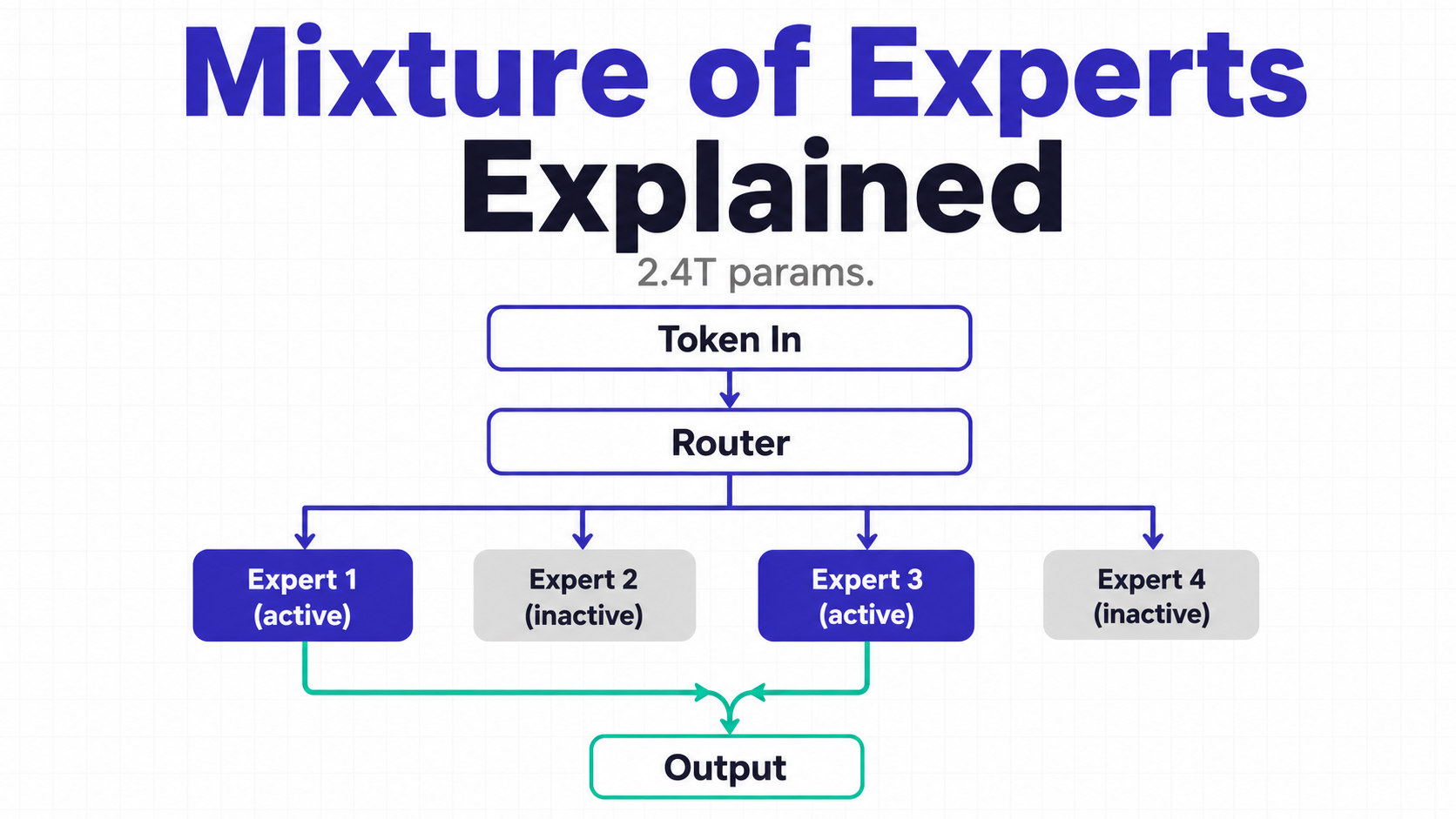
MoE layers replace a dense feed-forward block with a set of expert sub-networks and a gating function that routes each token to a small number of experts. Only the selected experts are activated for a given token, so the number of parameters touched per forward pass is a fraction of the total parameter count. MoE is the main way production systems decouple model capacity from inference cost.
The architecture has two core components:
- Experts. In standard transformer-based MoE models, the dense feed-forward network layers are replaced by a layer of multiple experts. Each expert is typically an independent feed-forward network. While the self-attention mechanism remains shared across the model, the experts specialize in processing distinct portions of the input space.
- The router (gating network). For an input token representation, the router computes a probability distribution over all available experts. To enforce sparsity, the model selects only the top-k experts with the highest gating scores, where k is significantly smaller than the total number of experts. The output of the MoE layer is the weighted sum of the selected experts’ outputs, scaled by their respective gating probabilities. Non-selected experts remain inactive, reducing floating-point operations.
The routing is learned during training. The model learns which experts are relevant for different types of inputs. Math tokens might activate different experts than code tokens or language tokens.
The result is a model that carries an enormous library of knowledge in its total parameters, but only consults the relevant specialists on each token.
The Two Numbers Every Developer Should Track
MoE separates active parameters, used per token, from total parameters, loaded in memory. A “400-billion-parameter model” may only run 17 billion per token. This shifts the inference cost equation: compute per token goes down, but memory footprint stays high.
This is the central trade-off, and it has two practical consequences:
Compute cost tracks active parameters, not total parameters. The floating-point operations per forward pass scale with the number of parameters that actually fire. A 2-trillion-parameter MoE that activates 22 billion parameters per token performs roughly as much arithmetic per token as a well-optimized 22-billion-parameter dense model.
Memory cost tracks total parameters. Despite only using a subset of parameters during inference, the entirety of the model’s parameters must be loaded into memory, meaning that the computational efficiency enjoyed by sparse MoE models in most regards does not apply to their RAM and VRAM requirements. A 2.4-trillion-parameter model at 4-bit precision needs roughly 1.2 terabytes for weights alone. A single Nvidia H200 carries 141 gigabytes. Even eight cards leave awkward math.
This is why the active-parameter count is the inference cost number, and why Alibaba’s omission of it for Qwen3.8-Max is so frustrating for practitioners trying to plan deployments.
A Real Example: Qwen3-235B-A22B
You don’t need to wait for Qwen3.8-Max’s specs to see this architecture in action. The already-released Qwen3-235B-A22B is a textbook illustration.
Qwen3-235B-A22B has 235 billion total parameters and 22 billion activated, spread across 94 transformer layers, 128 experts, with 8 experts activated per token.
The model utilizes a sparse MoE transformer framework consisting of 128 total experts. During any single inference pass, the routing mechanism dynamically selects and activates 8 experts per token, resulting in approximately 22 billion active parameters from a total pool of 235 billion.
That active-to-total ratio is about 9.4 percent. The compute budget per token matches a roughly 22-billion-parameter dense model, while the knowledge capacity stored in weights is ten times larger. The flagship Qwen3-235B-A22B scores 95.6 on ArenaHard and 2056 on CodeForces Elo, outperforming DeepSeek-R1 on 17 of 23 benchmarks — results that would be implausible for a true 22-billion-parameter dense model.
The subtitle of this article is exactly what Alibaba’s engineering team executed: a 235-billion-parameter model that serves like a 22-billion-parameter one.
The Broader Trend: MoE Is Now the Default
Nearly every major open-weight large language model released in 2025 and 2026 uses a Mixture of Experts architecture, including Llama 4, DeepSeek V4, Qwen 3.6, Kimi K3, and more.
The active-to-total ratio keeps dropping: roughly 25 percent in early models like Mixtral, down to about 4 percent in Llama 4 Maverick and Qwen 3.5, and roughly 3 percent in DeepSeek V4 Pro. The trend is toward bigger total capacity with an ever-smaller active slice, squeezing more knowledge into the same per-token compute budget.
A key theoretical justification comes from scaling laws research. For a fixed compute budget, a sparse MoE model consistently achieves lower loss than a dense model trained to the same compute budget, because MoE allows you to scale the number of parameters independently of the compute per token. The scaling laws that govern dense models break down for sparse models in a productive way: you get more parameters without proportionally more compute per token.
Qwen3.8-Max vs. Kimi K3: The July 2026 Context
Qwen3.8-Max did not arrive in a vacuum. It arrived two days after Moonshot AI released Kimi K3, a 2.8-trillion-parameter open-weight model.
Beijing’s Moonshot AI released Kimi K3 just three days before Qwen 3.8’s preview. Kimi K3 is both larger on paper and already shipping with open weights, while Qwen 3.8 is still a preview with its weights pending.
For developers making practical decisions today, the comparison currently favors Kimi K3 on readiness. Kimi K3 currently wins on decision confidence: it has clearer documentation, transparent API pricing, more benchmark evidence, and a confirmed context window. Kimi K3 has an audited score on Artificial Analysis, the Arena frontend ranking, and weights that are essentially available.
Although Kimi K3 remains the larger model at 2.8 trillion parameters, the difference in size alone does not determine which model performs better. What will matter most is how these models compare in reasoning, coding, agent workflows, benchmark scores, and real-world applications — and those comparisons require Alibaba to publish actual numbers.
In the one direct head-to-head test conducted by Trilogy AI on a 269-file repository architecture task, Kimi K3 scored 83 out of 100 and Qwen 3.8 Max scored 80, a narrow 3-point edge to Kimi. That’s a single data point, not a verdict.
What Actually Determines Inference Cost
To summarize the architecture lesson concretely:
- Total parameters determine how much GPU memory you need to load and serve the model.
- Active parameters per token determine the floating-point operations per forward pass, and therefore the compute cost and latency per token.
- In a well-designed sparse MoE, these two numbers can differ by an order of magnitude or more.
- A vendor who tells you only the total parameter count is giving you the storage spec, not the inference cost spec.
MoE wins on cost when GPUs stay saturated. It loses badly at low utilization. At high request volume with good batching, MoE’s economics are compelling. At low-throughput workloads where GPUs sit idle between requests, the memory overhead of loading all those total parameters works against you.
FAQ
What is the difference between total parameters and active parameters in a MoE model?
Total parameters are all the weights stored in the model, which must be loaded into GPU memory. Active parameters are the subset that actually compute on any given token during a forward pass. In a sparse MoE, only a small fraction of experts activates per token. MoE separates active parameters, used per token, from total parameters, loaded in memory. A “400-billion-parameter model” may only run 17 billion per token.
How does Mixture of Experts reduce inference cost?
Since only a subset of experts is activated for an input token, the number of parameters activated is significantly smaller than the overall number of parameters in the large language model, which translates to fewer floating-point operations and faster inference. This allows one to build extremely large networks without a corresponding increase in inference costs. The router learns during training which experts handle which kinds of inputs, so routing is fast and does not erase the savings.
What do we actually know about Qwen3.8-Max as of July 22, 2026?
The model uses a sparse Mixture-of-Experts architecture. It has 2.4 trillion total parameters, but only a fraction activate for any given task, which keeps the model efficient enough to actually run at massive scale. However, Alibaba has not disclosed how many parameters activate per token, which is the number that actually determines speed and cost. Open weights are promised “soon,” but no release date or license has been named.
How does Qwen3.8-Max compare to Kimi K3?
Kimi K3 offers the stronger practical case today, with documented API access, a 2.8-trillion-parameter architecture, a 1-million-token context window, multimodal capabilities, tool calling, and published pricing. Qwen3.8-Max may close or exceed that gap once Alibaba publishes its model card, standard API pricing, and independent benchmark results — none of which existed as of July 22, 2026.
The Takeaway
The headline number on any frontier model announcement is total parameters. The operationally meaningful number is active parameters. Sparse MoE architecture is specifically designed to make those two numbers diverge as far as possible, storing vast knowledge cheaply while keeping per-token compute tight. Qwen3.8-Max’s 2.4-trillion-parameter announcement is architecturally coherent and technically plausible precisely because of this design — but without the active-parameter count, developers cannot price out a deployment. Watch for that figure, along with an independent benchmark table and open weights, before drawing conclusions.
For clear video breakdowns of architectures like MoE, transformer internals, and AI engineering concepts, subscribe to Webronaq on YouTube — the channel publishes step-by-step lessons on computer science, AI, and software engineering built for developers who want to understand what’s actually happening under the hood.