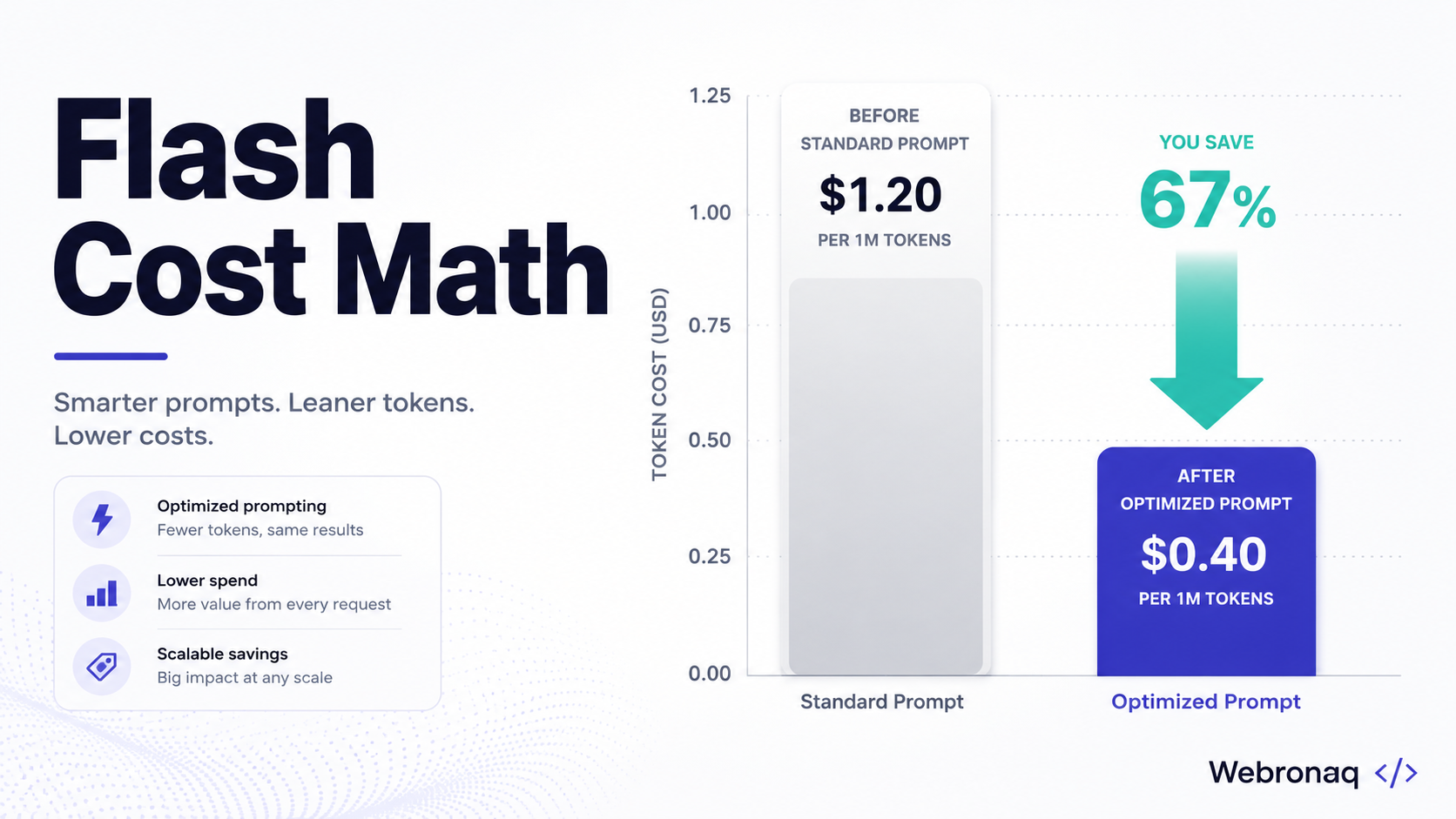
If you’re running AI agents at scale, the Gemini 3.6 Flash vs 3.5 Flash cost comparison comes down to two concrete changes: a lower output token price and fewer tokens generated per task. Understanding how those two factors interact — and where they don’t stack the way the math suggests — is what determines whether upgrading makes sense for your pipeline.
What Actually Changed: Pricing and Token Efficiency
Google released Gemini 3.6 Flash on July 21, 2026, alongside two other models. The pricing change is straightforward: output tokens dropped from $9.00 to $7.50 per million, a 16.7 percent reduction, while input pricing held at $1.50 per million — identical to Gemini 3.5 Flash.
The second change is about verbosity. According to the Artificial Analysis Index, Gemini 3.6 Flash uses 17 percent fewer output tokens on average compared to Gemini 3.5 Flash. Google cites this figure directly in its launch announcement; Artificial Analysis’s own published analysis independently confirms the 17 percent average reduction on their benchmark suite. It represents an average across a diverse benchmark suite, not a guarantee on any specific workload.
Gemini 3.6 Flash is a proprietary, closed-weights model available via the Gemini API through Google AI Studio, Vertex AI, Android Studio, and Google Antigravity. Weights are not publicly released.
Why Agent Workloads Amplify Every Token Change
A single-shot chatbot call generates output tokens once. An AI agent loops: it reasons, calls a tool, reads the result back into context, then reasons again for the next step. Each loop produces a fresh round of output tokens, and the growing conversation history gets re-sent as input on every subsequent step.
A task that a chatbot completes in one pass might take an agent eight to ten steps, multiplying your token bill by roughly that factor. Output token pricing commonly exceeds input token pricing at major API providers by several times, though the exact ratio varies by provider and model tier. That asymmetry means output-token savings hit agent budgets harder — in both directions — than they hit simple request-response workloads.
Context length matters here too. As an agent accumulates tool results and intermediate reasoning across steps, input costs compound alongside output costs. The longer and more complex the task, the more every per-token saving is worth.
The Compound Saving: What the Math Actually Promises
Combining a 16.7 percent output price cut with a 17 percent reduction in tokens generated yields a theoretical compound saving of roughly 31 percent on output spend — though Artificial Analysis’s own benchmark measurement found a realized cost-per-task reduction of approximately 18 percent, from $0.59 to $0.50. Actual savings depend on workload mix, input-to-output ratio, and context length.
The gap between 31 percent theoretical and 18 percent measured exists for a structural reason: the 31 percent figure assumes output tokens dominate your cost. In Artificial Analysis’s diverse benchmark suite, input tokens account for a meaningful share of total spend, which dilutes the output-only gains. If your pipeline is already output-heavy — long chains of reasoning with short prompts — your realized savings will sit closer to the theoretical ceiling. If your workload is input-heavy, with long context windows and short model replies, the ceiling is lower.
For a concrete illustration: a pipeline burning 10 million output tokens per day at the old $9.00 rate costs $90 daily. At $7.50 with 17 percent fewer tokens generated, that same workload costs roughly $62 — about $28 saved per day. That estimate holds only when output tokens drive the majority of spend.
Capability Gains vs. Efficiency Gains: Reading the Benchmarks Honestly
The benchmark picture for 3.6 Flash is split, and reading it carefully matters before making decisions.
On the capability side, Google vendor-reported results show 3.6 Flash scoring 49 percent on DeepSWE, up from 37 percent for 3.5 Flash, and 63.9 percent on MLE-Bench, up from 49.7 percent. These are vendor-reported figures; no independent re-run of those benchmarks was available as of July 23, 2026. Google also vendor-reports up to 65 percent fewer output tokens on DeepSWE specifically, which explains a large share of the cost reduction on long-horizon coding tasks.
On the general reasoning side, the picture is different. On the Artificial Analysis Intelligence Index v4.1, Gemini 3.6 Flash scores 50 — identical to Gemini 3.5 Flash. That is an independent result. The model is measurably more efficient on certain task types, but it is not measurably more capable on general reasoning. If your agent workload is general-purpose rather than coding-focused, the capability argument for upgrading is weak; the cost argument may still stand.
When to Use 3.6 Flash, When to Drop to Flash-Lite
The more useful framing is not whether to upgrade from 3.5 Flash to 3.6 Flash, but how to route across two tiers.
Gemini 3.6 Flash at $7.50 per million output tokens is the right choice for complex multi-step reasoning, agentic coding loops, and tasks where getting the right answer in fewer steps saves more than the per-token difference. The vendor-reported efficiency gains on DeepSWE suggest it is particularly well-suited to long-horizon software engineering tasks.
Gemini 3.5 Flash-Lite, priced at $0.30 input and $2.50 per million output tokens, runs at 350 output tokens per second as measured by Artificial Analysis in pre-launch testing — faster than the standard Flash tier and substantially cheaper. For high-volume, lower-complexity steps like classification, entity extraction, or document tagging, routing to Flash-Lite is where the largest absolute dollar savings typically live.
The routing decision depends entirely on your workload’s complexity distribution. An agent that mixes hard reasoning steps with large volumes of simple classification calls is a strong candidate for two-tier routing. A pipeline of uniformly complex tasks is not.
Making the Switch: What to Change and What to Verify First
The mechanical change is a model string swap: replace gemini-3.5-flash with gemini-3.6-flash in your API calls. Both models are available as proprietary API endpoints via Google AI Studio and Vertex AI.
Before committing that change to production routing, run a representative sample of your actual workload through both models and measure output token counts directly. The 17 percent average reduction is a figure from the Artificial Analysis Index across a mixed benchmark suite; your pipeline’s specific prompt structure, task type, and expected output length will determine your actual reduction. Check output quality on the same sample — particularly if your tasks are general-purpose rather than coding-focused, given that general reasoning scores are unchanged.
If you add a Flash-Lite route for simpler steps, verify that Flash-Lite’s output quality meets your threshold for those specific tasks before routing production traffic. Speed and price are only advantages if the outputs are usable.
For broader context on why this matters now: according to Cloud Magazin’s analysis of the FinOps Foundation’s 2026 State of FinOps Report, at AI-affine organizations, AI workloads represent 18 percent of total cloud spend, up from 4 percent in 2023, and 73 percent of enterprises exceeded their AI cost projections in the past year. A model that reduces output token volume and price simultaneously is directly responsive to that pressure — provided you measure the savings on your workload rather than assuming the average applies.
The clearest takeaway: Gemini 3.6 Flash is a meaningful cost improvement for output-heavy agentic pipelines, a modest improvement for mixed workloads, and a lateral move on general reasoning capability. Combining it with Flash-Lite routing for simpler steps is where the largest realized savings are likely to come from, though the exact numbers depend on your pipeline’s shape.
Watch the full video walkthrough and subscribe to Webronaq on YouTube for more computer science, AI, and software engineering lessons.
FAQ
Is Gemini 3.6 Flash more capable than 3.5 Flash?
On general reasoning, no — both score 50 on the Artificial Analysis Intelligence Index v4.1, an independent result. On coding and ML research tasks specifically, Google vendor-reports meaningful benchmark gains (49 percent vs. 37 percent on DeepSWE), but those figures have not been independently re-run as of this writing.
Are Gemini 3.6 Flash weights available to download?
No. Gemini 3.6 Flash is a proprietary, closed-weights model. It is available exclusively via the Gemini API through Google AI Studio, Vertex AI, Android Studio, and Google Antigravity. No open-weights release has been announced.
What is Gemini 3.5 Flash-Lite best used for?
High-volume, lower-complexity tasks — classification, entity extraction, document tagging — where speed and cost matter more than deep reasoning. Artificial Analysis measured 350 output tokens per second in pre-launch testing (a figure Google’s own blog also cites), and output pricing is $2.50 per million, compared to $7.50 for 3.6 Flash.
When is Gemini 4 coming?
Google has confirmed that Gemini 4 pre-training has begun, but no release date is publicly known. Gemini 3.5 Pro is in partner testing and is not yet broadly available, according to Google’s July 21, 2026 announcement.
Sources
- Introducing Gemini 3.6 Flash, 3.5 Flash-Lite, and 3.5 Flash Cyber — Google DeepMind (primary)
- Gemini 3.6 Flash and Gemini 3.5 Flash-Lite: Halving Time per Task — Artificial Analysis (independent)
- Gemini 3.6 Flash – Intelligence, Performance & Price Analysis — Artificial Analysis (independent)
- Gemini 3.5 Flash – Intelligence, Performance & Price Analysis — Artificial Analysis (independent)
- Gemini 3.5 Flash-Lite – Intelligence, Performance & Price Analysis — Artificial Analysis (independent)
- State of FinOps 2026 Report — FinOps Foundation (primary)
- The inference calculation that no one budgeted — Cloud Magazin (secondary)