Introduction to Calculus: Real Numbers, Intervals, and Inequalities Made Simple
The three foundations every calculus student must master first
Before I started teaching calculus, I used to think students struggled with the subject because of complex derivatives or tricky integrals. But after years of guiding learners, I realized the real problem starts much earlier. Most students find calculus hard because they never built a strong foundation in three basic ideas: real numbers, intervals, and inequalities. In this article, I will walk you through these three building blocks in simple language, with clear examples, so you can begin your calculus journey with confidence.
Understanding Real Numbers
Real numbers are the numbers we use every day. They include whole numbers like 3, fractions like 1/2, decimals like 0.75, negative numbers like −8, and even special numbers like π (pi) and √2.
Real numbers are divided into two main groups:
Numbers that can be written as a fraction of two integers. For example, 4 (which is 4/1), 0.5 (which is 1/2), and −7/3 are all rational. Decimals that either end (like 0.25) or repeat in a pattern (like 0.333…) are also rational.
Numbers that cannot be written as a simple fraction. Their decimal form goes on forever without repeating. The most famous examples are π ≈ 3.14159… and √2 ≈ 1.41421…. The Greek mathematician Hippasus of Metapontum is credited with discovering irrational numbers around the 5th century B.C., when he proved that √2 cannot be expressed as a ratio of two integers.
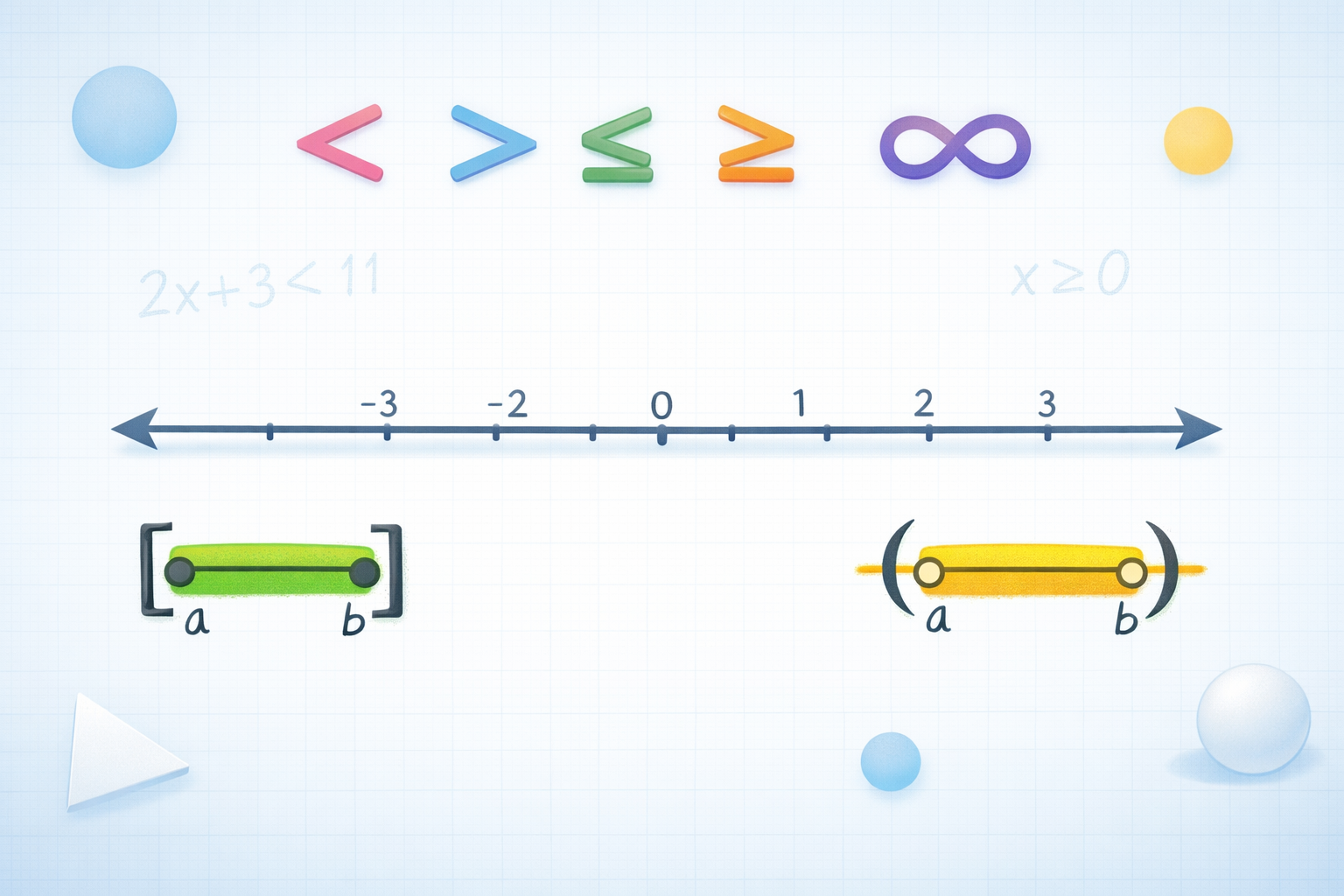
When we combine all rational and irrational numbers, we get the set of real numbers, often written with the symbol ℝ. We can picture real numbers as points on a horizontal line called the real number line, where zero sits in the middle, positive numbers go to the right, and negative numbers go to the left.
What Are Inequalities?
An inequality is a mathematical statement that compares two values. Unlike an equation, which says two things are equal, an inequality tells us one value is bigger or smaller than another.
The four main inequality symbols are:
| Symbol | Meaning | Example |
|---|---|---|
| < | Less than | 3 < 5 |
| > | Greater than | 7 > 2 |
| ≤ | Less than or equal to | x ≤ 10 |
| ≥ | Greater than or equal to | h ≥ 48 |
Suppose a roller coaster requires riders to be at least 48 inches tall. If h stands for a rider’s height, then the rule is h ≥ 48. Any height of 48 inches or more satisfies this inequality.
Solving a Basic Inequality
Let us solve 2x + 3 < 11.
2x < 11 − 3
2x < 8
x < 4
So the solution is all real numbers less than 4.
When you multiply or divide both sides of an inequality by a negative number, you must flip the inequality sign. For example, if −2x < 6, dividing both sides by −2 gives x > −3, not x < −3.
Introducing Intervals
An interval is simply a continuous section of the real number line. Instead of writing long inequalities, we use a cleaner shorthand called interval notation. This notation appears constantly in calculus when describing the domain of a function, the limits of integration, or where a function is increasing or decreasing.
There are three main types of intervals:
Endpoints are not included. We use round parentheses.
Every real number strictly between 2 and 7, but not 2 or 7 themselves.
Endpoints are included. We use square brackets.
Both 1 and 5 are part of the set.
One endpoint is included, the other is not.
Useful when something has a starting point but no fixed end, like a race that starts at time 0.
Dealing with Infinity
When an interval stretches forever in one direction, we use the infinity symbol ∞. Since infinity is not an actual number, we always place a parenthesis next to it, never a square bracket.
| Inequality | Interval Notation |
|---|---|
| x > 3 | (3, ∞) |
| x ≤ −2 | (−∞, −2] |
| All real numbers | (−∞, ∞) |
A Practical Example
A doctor recommends that an adult should drink between 2 and 3 liters of water per day, including both amounts. If w represents water intake, the inequality is 2 ≤ w ≤ 3, which in interval notation is [2, 3].
A diet plan suggests consuming more than 1500 but no more than 1800 calories daily. The inequality is 1500 < c ≤ 1800, which in interval notation is (1500, 1800].
Why These Concepts Matter in Calculus
These three ideas are not just abstract symbols. They form the language of calculus itself. When we talk about the domain of a function, we describe it using intervals. When we study limits, we examine what happens as x approaches a value from within an interval. When we prove that a function is continuous on a certain range, we rely on inequalities to show that values stay close together.
The function f(x) = √x is only defined when x ≥ 0, which means its domain is the interval [0, ∞). Without understanding intervals, writing this simple fact would be confusing.
Key Takeaways
- Real numbers give us the playing field — they include every rational and irrational number on the number line.
- Inequalities let us compare values and describe ranges using symbols like <, >, ≤, ≥.
- Intervals help us describe collections of numbers neatly using parentheses and brackets.
- Always flip the inequality sign when multiplying or dividing by a negative number.
- Infinity (∞) always gets a parenthesis, never a bracket.
Spend time practicing these basics, and the rest of calculus will feel far less intimidating.
Continue Learning With Me
I have written more on foundational math topics in my books, and I share video lessons regularly. Let’s stay connected!